

Watch lecture recordings from Russian Science Day on the website of the National Centre RUSSIA

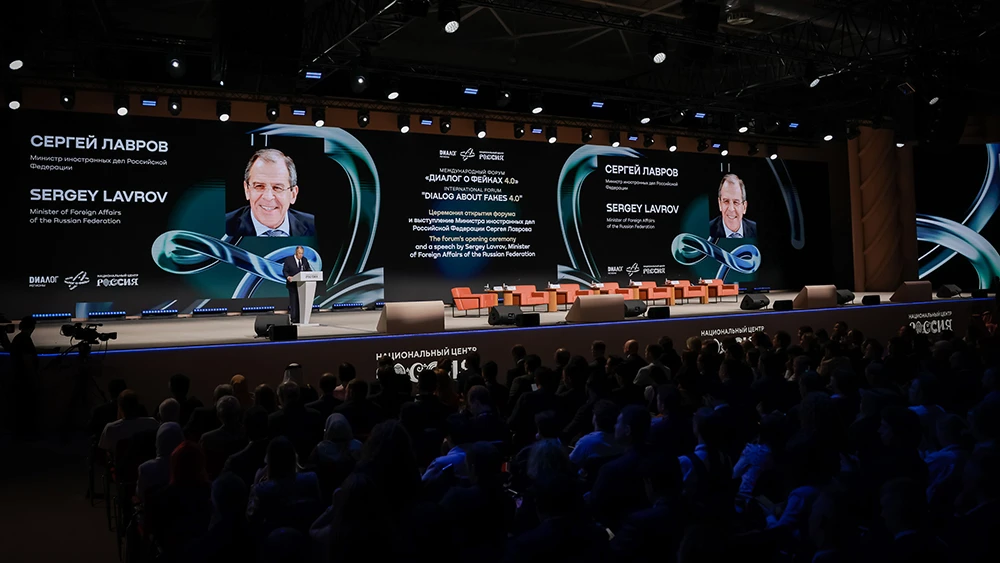
Russian Science Day was held on 8 February at the National Centre RUSSIA, bringing together more than 2,000 leading scientists, science communicators and media experts. Throughout the day, speakers shared their experience and cutting-edge developments, and discussed how the scientific ecosystem works, where it is heading, and why scientists are the new heroes of our time. Those who were unable to attend Russian Science Day at the National Centre RUSSIA can watch the video recordings on the russia.ru website.
According to the VCIOM data, more than 675,000 people were employed in research and development in Russia in 2024. The country ranks ninth globally in terms of investment in science. Public trust in scientists remains consistently high, and an increasing number of Russians would like their children to devote their lives to this field. These figures were presented by the Director General of the VCIOM Analytical Centre, Valery Fedorov, during Russian Science Day.
Throughout the day, lectures were held across the spaces of the National Centre RUSSIA, where scientists spoke about their achievements and answered audience questions. For example, the Doctor of Biological Sciences, Professor of the Faculty of Biology at Lomonosov Moscow State University, Vyacheslav Dubynin, delivered the lecture "Scientific Foundations of a Healthy Lifestyle", in which he discussed, among other things, how to improve personal productivity, why quality sleep matters, and the importance of a varied diet.
What is graphene, where can it be used, and why is it not produced on an industrial scale? Can quantum computers change the future of humanity? Are the latest telescopes capable of finding a planet similar to Earth? These and many other questions were addressed in the lecture "Achievements of Modern Physics" by the graduate of the Moscow Institute of Physics and Technology, physicist and science blogger Dmitry Pobedinsky.
Mathematics is not just formulas and calculations, but a universal foundation on which world art has been built throughout history. This is the view of the Doctor of Physical and Mathematical Sciences, Associate Professor of the Mechanics and Mathematics Faculty at Lomonosov Moscow State University, and publisher of the popular science online media outlet "N+1", Andrei Konyayev. In his lecture "How Mathematics Creates Art", he explored the connections between mathematical fractals and shikharas in Hindu architecture, as well as between the Flying Dutchman from "Pirates of the Caribbean" and the Navier–Stokes equation.
What are neuromorphic computing devices and why are they based on the principles of the human brain? This topic was covered in the lecture "Neuromorphic Systems — A Nature-Inspired Paradigm of AI Computing" by the Doctor of Physical and Mathematical Sciences, First Deputy Head for Research at the Kurchatov Complex of NBICS Nature-Like Technologies, Vyacheslav Demin.
In addition, a substantial lecture titled "AI That Thinks: Beyond Big Data" was delivered by the Doctor of Physical and Mathematical Sciences, Professor of the Russian Academy of Sciences, Director General of the AIRI Institute, and Dean of the Faculty of Artificial Intelligence at Lomonosov Moscow State University, Ivan Oseledets. According to the scientist, Russia is a global leader in the implementation of AI in the banking sector, while neurotechnologies are also demonstrating strong results in Moscow’s healthcare system.
The event was organised by the National Centre RUSSIA with the support of the Ministry of Science and Higher Education of the Russian Federation, the VCIOM Analytical Centre, and the Russian society Znanie.