


Divnogorye: the treasure of the Voronezh region
As part of the exposition "Region-2030. Platform of the Future" at the National Centre RUSSIA, the Days of the Voronezh Region are underway.
Divnogorye: A Crossroads of Eras and Cultures
Every region of Russia has its own unique treasures that shape its cultural code and attractiveness. For the Voronezh region, such a landmark site and one of the most beloved places for tourists is the natural architectural and archaeological museum-reserve "Divnogorye". This complex of monuments, located at the confluence of the Tikhaya Sosna river and the Don, represents a symbiosis of ancient history, unique nature and efforts to preserve it.
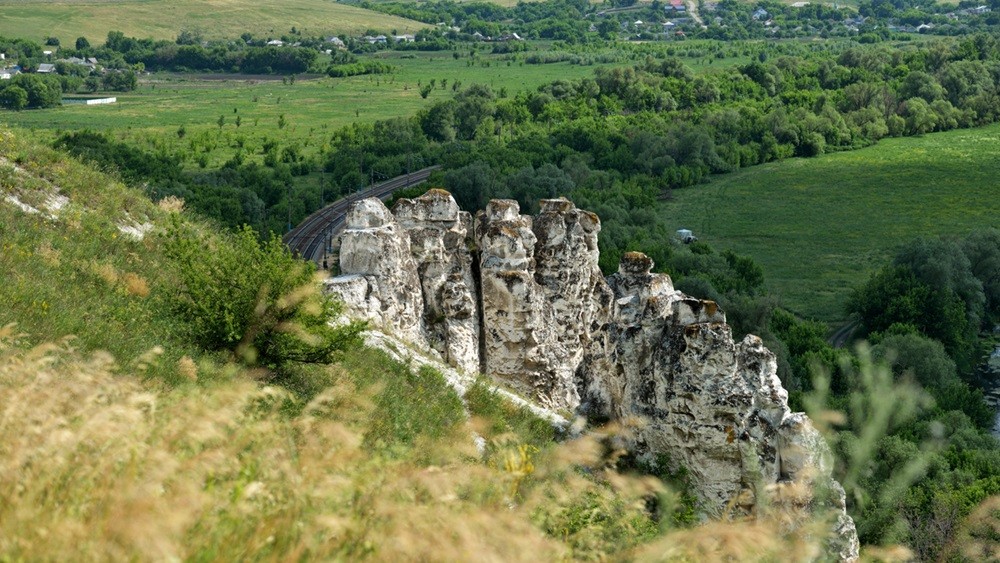
It is a plateau with chalk buttes — parts of rock formations that, under the influence of weathering, have taken on unusual shapes. The chalk mountains appeared here due to the sea that covered Divnogorye 137 million years ago. In some places of the reserve, these buttes resemble pillars, which were long ago called "divo" ("miracle"). There is also an extensive complex of chalk caves that used to be inhabited by monks.
The idea of creating a reserve in this place was first voiced in 1917 by geographer V. P. Semenov-Tian-Shansky. However, its realisation took decades. The idea returned in the 1970s thanks to Doctor of Historical Sciences S. A. Pletneva, head of the international Soviet-Bulgarian-Hungarian expedition. Significant contribution was made by Voronezh professor A. Z. Vinnikov. Crucial support came from the public after a publication in Pravda newspaper in 1987. As a result, in 1988 a branch of the Voronezh Regional Museum of Local Lore was created, and since 1991 Divnogorye has become an independent cultural institution.
Historical and Archaeological Legacy
The territory of the museum-reserve is exceptionally rich in archaeological monuments of different eras:
A site of ancient horse hunting was discovered here, and the collection of Upper Pleistocene horse remains is the largest in the world.
The key object is the northernmost fortress of the Khazar Khaganate — the oldest stone fortification in Central Russia, after which an entire archaeological culture is named.
The study of the Mayatsky complex made it possible to reconstruct and revive medieval Alan-Bulgar pottery. Based on the excavations, the only archaeological park in the region was created, with a model of the Mayatskaya fortress and a children’s museum space. The Divnogorsky male monastery is also located in the reserve.
More than 80 archaeological monuments are known within the protected zones, and their number continues to grow thanks to annual work by the reserve’s staff and leading academic institutes.
In addition to material heritage, Divnogorye also preserves intangible legacy — the unique traditions of the local population, formed by migration flows from central Russia and the Dnieper region in the 17th century. Materials collected by the museum’s staff became the basis for the ethnographic exposition "Divnogorye Homestead".
Nature of Divnogorye
The nature of Divnogorye is equally unique. Its flora includes more than 850 species of vascular plants, over 50 of which are protected at federal and regional levels, and 14 are endemics. Many are calciphiles growing on chalk deposits left by four ancient seas. The chalk pillars-divos, natural monuments, gave the area its name. Six cave complexes are also known in the chalk strata. Its fauna is equally diverse, including over 40 endemic insect species.
Thanks to conservation measures and the creation in 2013 of the "Natural and Cultural Complex 'Divnogorye'" with an area of 17,639 hectares, the restoration of steppe communities is underway. In 2016, the site was granted the status of a federal monument, and in 2020 it was included in the Tentative List of UNESCO World Heritage.
Modern Life of the Museum-Reserve
Divnogorye represents the result of long-term interaction between humans and nature, forming a unique complex filled with monuments of different eras and having no direct analogues. The site attracts more than 100,000 visitors a year. The programme includes thematic tours, workshops on archaeology, botany, geology and history, new exhibitions and large-scale events such as the "Night in Divnogorye" festival.
The National Centre RUSSIA invites you to visit the exposition "Region-2030. Platform of the Future" and explore the treasures of the Voronezh region. As part of the Days of the region, cultural and educational programmes are held throughout the week: workshops, lectures by renowned speakers and the vibrant atmosphere of the Voronezh region.

Its central theme was the development of visual culture through educational projects, public spaces and new approaches to environmental design.

The Summer Expert Meetings will be held at the National Centre RUSSIA in July.

Experts from the Centre for Cross-Industry Expertise "Third Rome" analysed the discussions and essays submitted by participants in the April event.


