


Guests of the National Centre RUSSIA took a "Journey Through the Vineyards of Kuban"

The lecture "Journey Through the Vineyards of Kuban" was held at the Gastronomic Rows of the National Centre RUSSIA. It was dedicated to viticulture as an important part of the history, economy and cultural code of the Krasnodar Territory. Guests were invited to look at Kuban not only as an agricultural region, but also as a territory with rich viticultural traditions and growing wine and gastronomic tourism. The expert was Yelena Zhurko, brand ambassador of the "Great Russian Wine" project.
"Wine and gastronomic tourism is now one of our leading areas in terms of tourist growth. Trust in our producers is emerging. People are interested in coming to the place itself, walking through the vineyard, seeing the landscape, and talking to agronomists and winemakers. It is no longer only about the product, but about a complete experience — about the history of the winery, the people and the land itself," Yelena Zhurko said.
During the lecture, participants followed a route from Anapa towards Novorossiysk and then on to Gelendzhik and Krymsk, learning how the diversity of landscapes and climates affects viticulture. They discussed open, windswept areas and vineyards surrounded by mountain ranges and forests, as well as different soil types — from limestone and well-drained slopes to heavy clays that retain moisture and heat. Through these examples, guests saw how varied the region is and how this diversity shapes its terroirs.

The expert also explained how approaches to grape growing have changed. Whereas previously vines were often left to grow like powerful lianas, with dozens of kilograms harvested from each bush, today a more "European" approach is increasingly used: dense planting, limiting the load on each vine, and careful control over the condition of the plant and harvest timing: "Today, one vine essentially means one bottle. Our vines are trained high, with 2–2.5 kilograms harvested from each. Extra bunches are cut off in spring, leaving only those that can fully ripen. The important thing is not to chase volume, but to work with the vine so that the berry gives exactly the character intended."
The lecturer spoke about the features of Kuban’s natural zones and vineyards in the Gelendzhik area, where vines grow almost inside a pine forest, in a zone where rare protected pine species bloom. An unusual microclimate forms there: a combination of almost subtropical heat, high humidity and an altitude of around 200–300 metres above sea level.
"In Gelendzhik, it is even hotter and more humid than in Anapa; it is a difficult zone. The more sun there is, the faster the berry gains sugar and loses acidity. Grapes sometimes have a 'hard time' there, but thanks to the altitude, the surrounding forest and the winds, a unique microclimate is created. This makes the region difficult to work with, but very interesting for winegrowers and tourists," the expert emphasised.
Guests learned that different parts of the Krasnodar Territory are home to wineries with different approaches to terroir and technology. In some zones, classic European varieties form the basis; in others, rarer varieties are used, including those only recently added to the Russian register. It was noted that modern producers are increasingly using alternative materials for ageing: in addition to steel, these include concrete and traditional clay vessels, which are now being revisited as an original way of working with grape juice. This makes it possible to reveal the potential of the same variety in different natural conditions in new ways.
"Kuban has its own path and its own style. Viticulture here is developing on the basis of local conditions and traditions, rather than by copying foreign regions. We have completely different terroirs and different approaches from those in old wine-producing countries. Even when we work with international varieties, the climate, soils and terrain make them our own. This is no longer an attempt to copy someone else, but a search for the region’s own voice," Yelena Zhurko concluded.
"Journey through the Vineyards of Kuban" became part of the educational programme of the National Centre RUSSIA and added another dimension to the story told by the "Geography Lessons" exposition — the history of the country’s southern regions through their landscapes, agriculture and people’s long-standing work with the land.
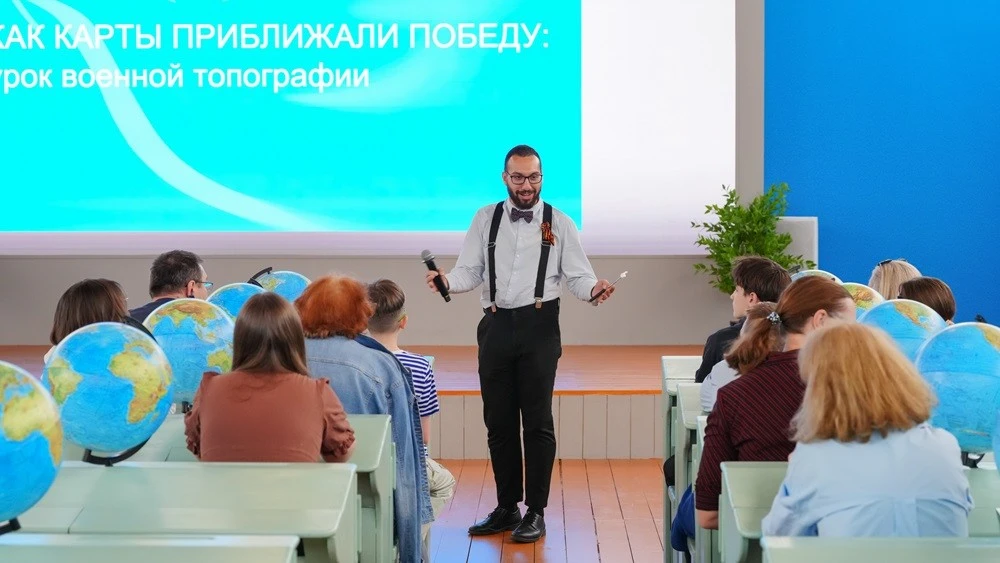
Geographical maps shaped the outcome of military battles no less than bullets and shells.

The performance "Soldiers’ Dreams" unites generations, recalls the heroism of a multi-ethnic nation and inspires new achievements.

The patriotic campaigns of the National Centre RUSSIA remind us how important it is to preserve the memory of the heroes of the past and support the heroes of the present.


