

The new Russian language: Literary Club guests explore how words shape the way we see the world at the National Centre RUSSIA
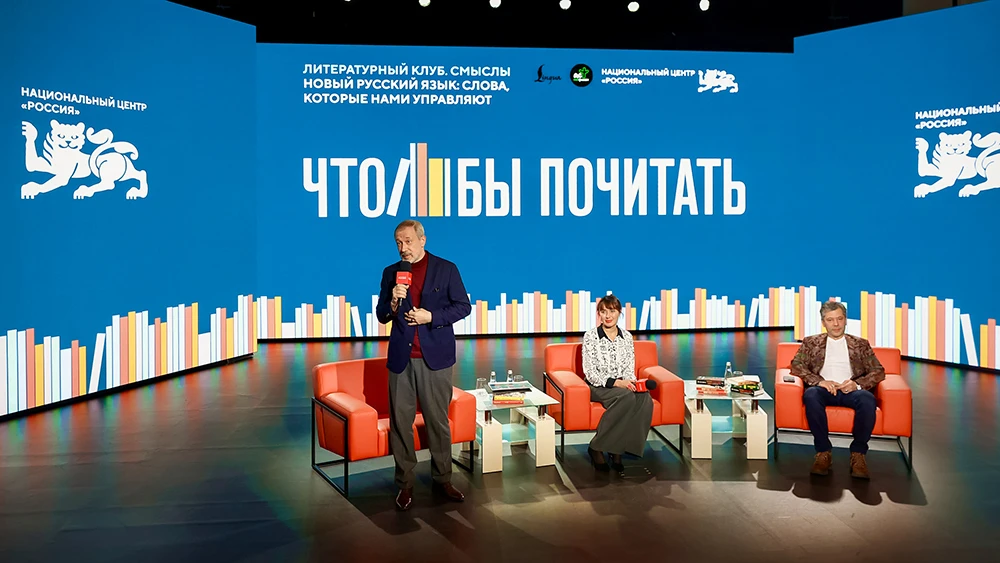
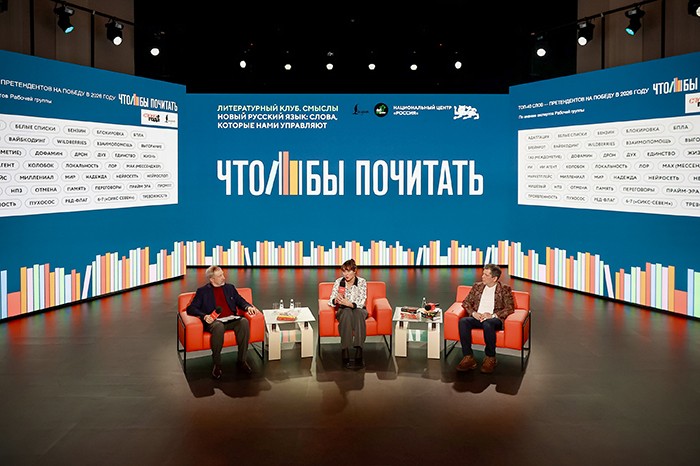
The discussion on how digital media and neural networks are changing everyday speech and the meanings we share as a society was held on 26 November at the National Centre RUSSIA, at the Literary Club "What to Read?! Meanings" meeting entitled "The New Russian Language: Words That Control Us". Guests learnt what part literature, experts and citizens themselves play in preserving linguistic culture.
The discussion was moderated by Alexei Chesnakov, Head of the Academic Council of the Centre for Political Conjuncture and a professor at HSE University. Opening the discussion, he mentioned two decrees signed by the President of Russia that day. The first, he said, establishes All-Russian Children's Book Day, which will be marked on 26 March. The second concerns next year's celebrations of the 125th anniversary of the birth of Gaito Gazdanov, a writer who worked in exile and whose work only returned to Russian readers in the 1990s. Alexei Chesnakov recalled that Gaito Gazdanov was of Ossetian origin and had a fine ear for Russian, and that the Russian language developed both within Russia and beyond its borders, among people of different nationalities.
Continuing the discussion, he also stressed that there was little point in making any one body responsible for the development of modern language: language is a living organism that evolves through everyone who speaks it.
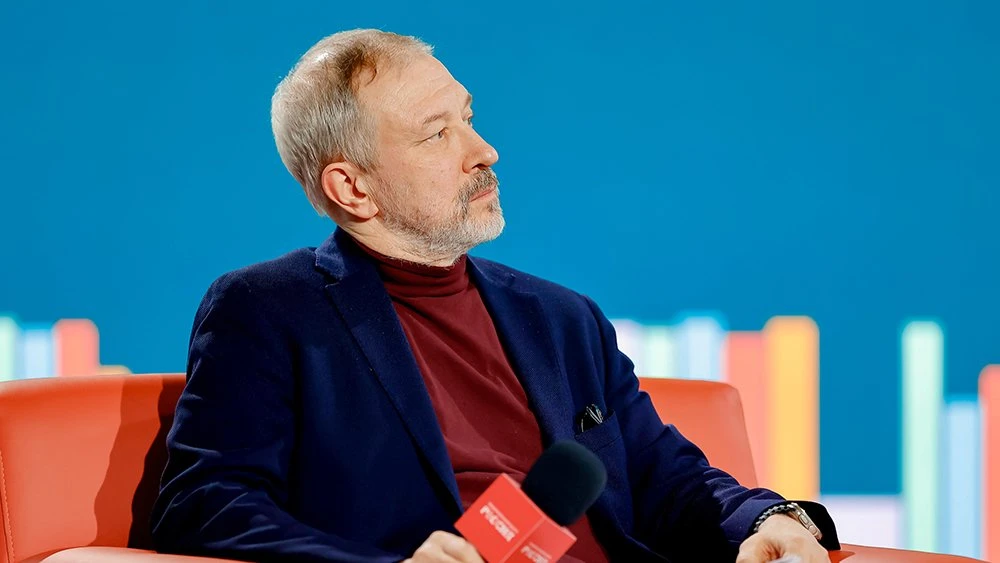
"Language is an organism we all inhabit, use and develop. It evolves with us, and we evolve with it. Many people and organisations should keep an eye on it. At the same time, we shouldn't put any one organisation in charge of it. Developing the Russian language is a task we all share," the expert explained.
Arkady Nedel, who holds a doctorate in philosophy and is a professor at Maurice Thorez Moscow State Linguistic University, took part in the discussion. He developed the point by looking at loanwords. He said that English technology terms now account for most of the words borrowed into everyday speech and that there is no way to freeze a language in time.
"I wouldn't call myself a purist, but I do try to keep the language pure. At least, I try. But language is a living organism, and there's nothing we can do about that. We can't freeze it in time or look at it as if it were an object in a museum. We're part of the process. Language often speaks through us, just as we speak through it," the philosopher said.
Yevgenia Larina, Director of the "Applied Literature and Cross-Publishing Projects" Department at AST Publishing House, Head of AST Nonfiction and organiser of the federal "Word of the Year" initiative, looked at the same changes through the figures: the "Word of the Year" initiative shows what matters to people. She divided new terms into three groups — technology terms, slang and words that bring us back to enduring values.
"On the one hand, there's interest in a new field, and on the other there's slang, where a great many new words have appeared that reflect the absurdity and chaos of our world as the boundaries between concepts really are becoming blurred. Broadly speaking, this word doesn't mean anything: it stands for something absurd and ridiculous that has practically no use in real life," she said.
Alexei Chesnakov suggested looking at the blurring of concepts from a practical perspective: in his view, dictionaries help us tell when someone is twisting the meaning of words in a conversation, including dictionaries of synonyms, which show how other languages interpret concepts. Language is also directly linked to the country's cultural sovereignty, and that applies to Russian as well as to the languages of Russia's peoples.
Arkady Nedel touched on semantic sovereignty, saying that there is no need to shut out words from other languages because a language will keep what it needs and discard what does not fit: "There's nothing wrong with new words coming into our language, and we'll work with them. The language itself will spit out what it doesn't need. Just look at how many French words we have in art and ballet, how many Italian ones we have in music and how many German ones we had in 20th-century engineering. The words we need will stick. The ones we don't need will disappear, and the language will take care of that itself. I'm against purism for its own sake: it will only do violence to the language".
One topic was the formats people use to read books today. According to Yevgenia Larina, audiobooks are well ahead of e-books among digital formats, though print still leads overall.
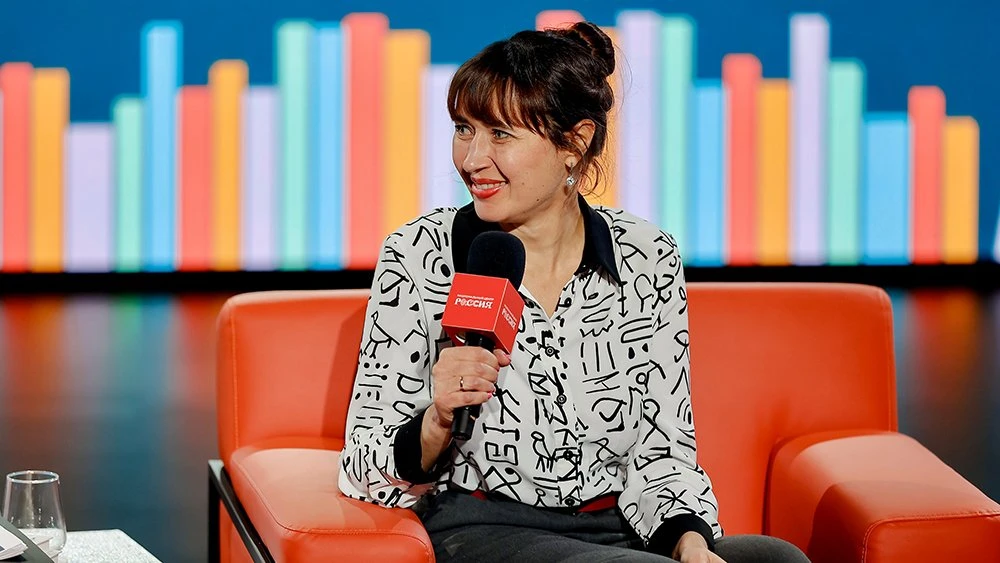
"If we're talking about digital formats, e-books account for just 30% and audiobooks for 70%. Yes, print still leads. It accounts for about 85% overall and just under 80% for fiction, because detective novels are mostly read as e-books. So yes, overall, print is still by far the most popular format," she said.
The expert noted that the same pattern holds almost everywhere in the world: the sole exception is Sweden, where audiobooks are unexpectedly popular.
Another topic was neural networks and their impact on both language and human thinking more broadly. Arkady Nedel suggested taking a calm view: we should compete with machines through intellect and feeling, where we still have an advantage.
"The machine has already overtaken us on every measure. We've lost on speed, but we still have a chance to win on intellect. Machines have no intuition and don't think irrationally. They have no feelings. We have all of those things. That's how we can still compete and keep things under control. I don't think some AI is going to enslave us all any time soon," said Arkady Nedel.
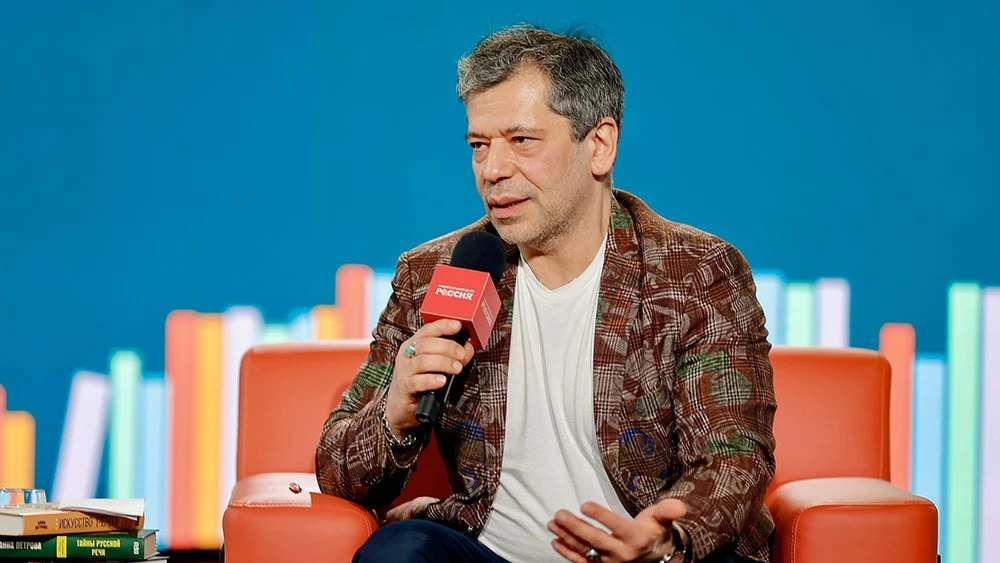
Yevgenia Larina noted that digital fatigue is already changing reading habits: demand for challenging books, classics and philosophy is growing, with sales of philosophy books up 40% over the past year.
"People are tired of the black mirror and want to slow down. Trends in contemporary literature show that people want to look for answers in the past, in timeless subjects. The classical Stoics — Marcus Aurelius and Seneca — are very relevant now, and their ideas are just as applicable today as they ever were. In difficult times, people also turn to poetry: it distils everything they are feeling into a few words," she explained.
She said that new words reveal something else as well. People are returning to simple, important concepts. Life, hope, peace and memory received many votes in the "Word of the Year" initiative, and after mindfulness, "authenticity" — the freedom to be yourself without fear — gained popularity.
Yevgenia Larina described publishing as a social mission. That means publishing serious literature that readers need alongside commercial titles and books by bloggers: "Serious literature is essential too, and publishing it is something of a social mission. We try to publish plenty of serious books for young adult readers: they started with comics and young adult fiction, but they're gradually taking an interest in more substantial subjects, and we're now publishing philosophy books in contemporary designs as well as non-fiction".
Wrapping up the discussion about words, Alexei Chesnakov warned against fashionable loanwords that displace precise Russian terms.
"People often use the English loanword 'random'. Russian already has a perfectly good word for something that happens by chance. Let's take care of the words we already have and keep them from being replaced by words that happen to slip into our speech. And, of course, let's treat new words with care as they emerge with the development of new technologies," he concluded.
During the meeting, the experts also discussed how new words and internet folklore affect communication between generations, why teachers of Russian language and literature are becoming some of the people who pass on linguistic culture, and how people with different experiences can keep a language in common.
The meeting was part of the Literary Club "What to Read?! Meanings" programme, which focuses on current questions in literature, culture and public life. The club brings together experts and readers to discuss books and ideas that help us understand the world today.

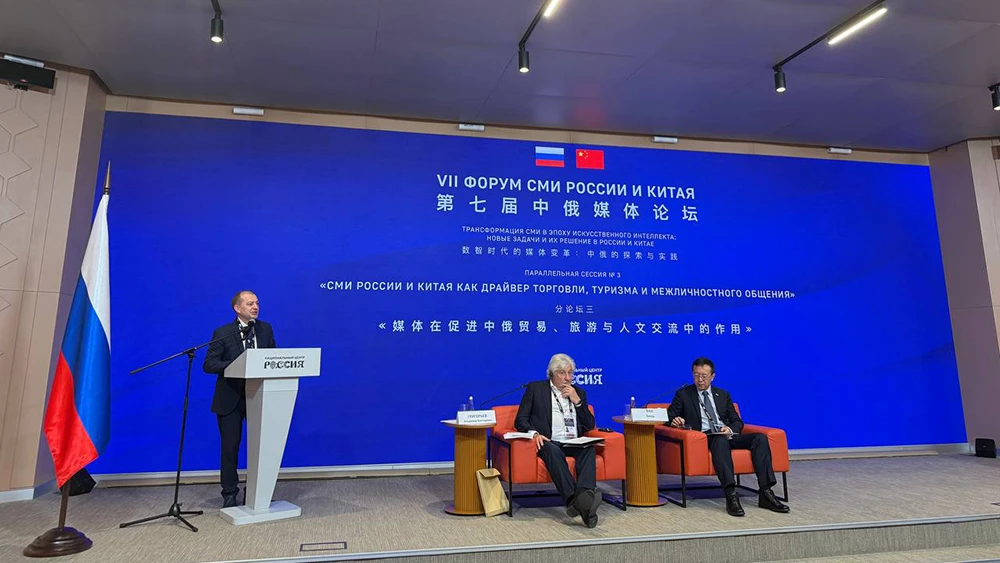
These were the initiatives proposed by the Director General of JSC "Channel One Russia Worldwide", Alexei Yefimov, at the VII Russia–China Media Forum at the National Centre RUSSIA.


