


"Where the Russian land began": myths and facts about Rus', Vikings and Slavs discussed at the National Centre RUSSIA
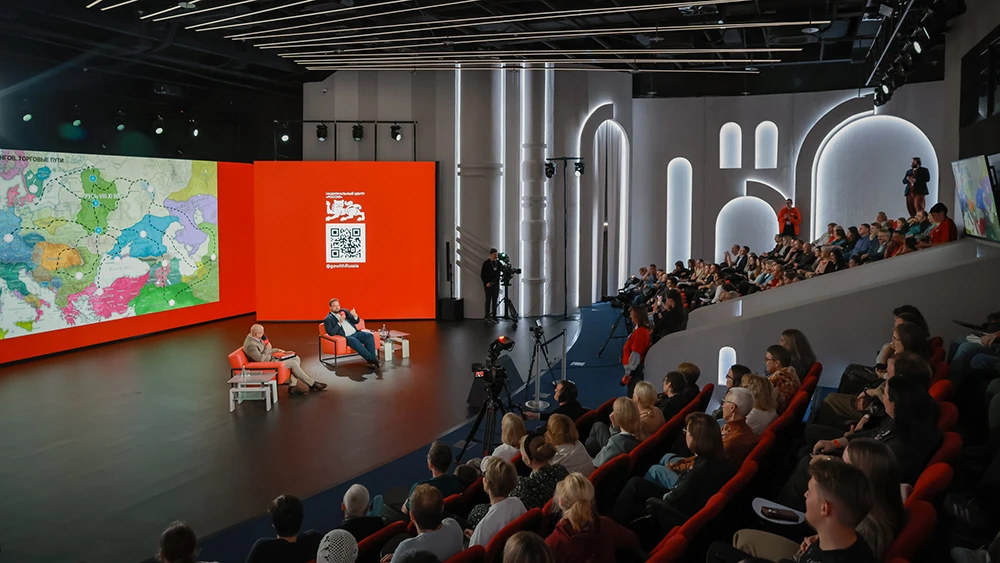
How did Ancient Rus' take shape, where did its first cities and principalities come from, and what did the Vikings — mysterious people of the North who left their homelands for unknown lands — have to do with it? These questions were discussed on 17 September at the National Centre RUSSIA's original educational event, the Lecture Hall "Myths and Facts about Rus', Vikings and Slavs". Historians and representatives of the professional community discussed with the audience the origins of the multinational character of our country and reflected on how Russian statehood emerged at the intersection of cultures and religious traditions. The meeting was held with the support of the Russian Military Historical Society and the "I Remember" Foundation.
The event's moderator, Artyom Drabkin, Director of the "I Remember" Foundation and member of the Academic Council of the Russian Military Historical Society, emphasised that discussions about the origins of Rus' today should be based on the ability to rely on archaeological evidence, work with sources, reconstruct the past and distinguish historical facts from persistent myths.
"Who, after all, stood at the origins of Rus': the Slavs or the Vikings? And is it even right to frame the question this way? People often say that the Slavs were incapable of certain things and that the Vikings were therefore needed to create a state. But in reality, the situation was different: both groups were indeed present. Each made its own contribution, and as a result our wonderful state emerged," Artyom Drabkin noted.
The origins and formation of Rus' are described by a wide range of sources, from Arab and Byzantine chronicles to archaeological excavations. Vasily Novikov, Candidate of Historical Sciences, Head of the archaeological expedition of the Gnezdovo Museum-Reserve and Project Director at the Tavolga Foundation, shared the results of modern archaeological research with the audience and highlighted the important role of discoveries in understanding the foundations of state formation.
"There are very few written sources on the early history of Rus', and they do not reflect the full picture of how the state developed. Archaeology allows us to expand that picture significantly, but not on its own — today it works hand in hand with anthropology and natural-science methods. Excavation data from Staraya Ladoga, Novgorod and other centres associated with the formation of the Old Russian state in the Viking Age provide a substantial increase in knowledge and reveal a picture that no chronicler ever recorded in writing. This is especially true now that scholars have reached a new level in understanding and using materials, with modern non-invasive methods, new approaches and broader syntheses being applied. This allows us to reconstruct the past at least in part, because of course we will never be able to know it one hundred per cent," said Vasily Novikov.
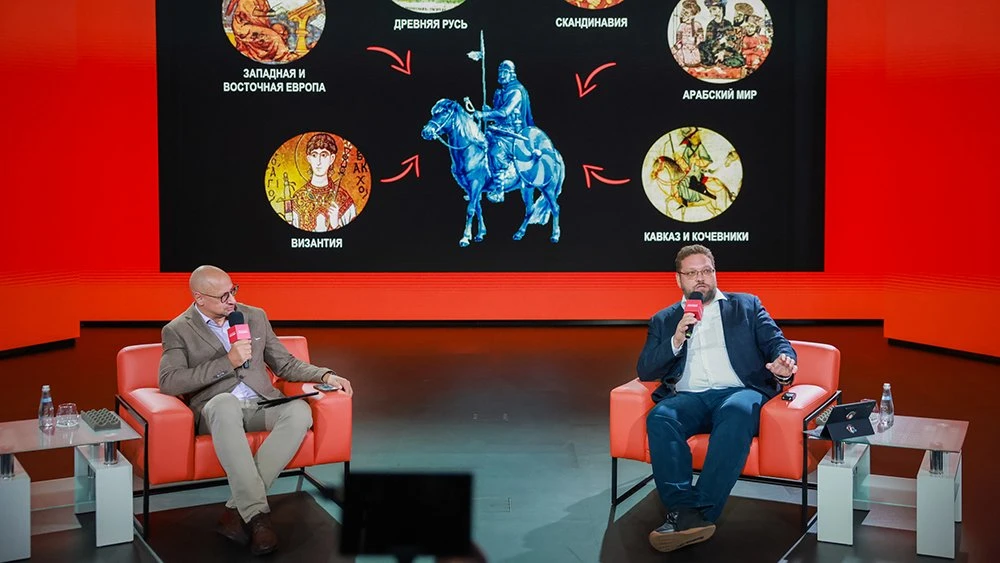
During the meeting, the experts addressed a wide range of topics: whether "The Tale of Bygone Years" actually existed in the form in which we know it, what role the Church played in the formation of the state, whether the dispute between Normanists and anti-Normanists has been overcome, and how interaction between Slavs and Vikings in transcontinental trade laid the foundations of statehood.
Participants also discussed the origins of the Slavs and Slavic ethnogenesis, the Viking Age and its heroes, trading partners and goods, as well as the formation of Ancient Rus' as a multi-ethnic, multi-confessional and multicultural centre.
"Rus' is an extraordinary 'infrastructure project'. From the very beginning, it rested on the same pillars that we present today in Russian society as part of our national idea. These are multi-ethnicity, multiculturalism and multi-confessionalism. Together, they all contributed to the creation of statehood," Vasily Novikov noted.
The event concluded with a traditional question-and-answer session. The Lecture Hall became another step towards understanding how history shapes public values and national identity.
"Our knowledge of our country is constantly changing, expanding and growing. Entirely new sources and new methods of understanding are emerging. That is why it is so important to understand how we came to stand so firmly on the foundations of our origins. And it is important to gain as much knowledge as possible in order to understand — who are we, Russians, after all? What do we bring into this world, and why are we the way we are? And, of course, in the past we are looking not only for answers about what happened, but also, among other things, about what awaits us in the future," Artyom Drabkin concluded.
The full recording of the Lecture Hall "Myths and Facts about Rus', Vikings and Slavs" is available on the National Centre RUSSIA website, russia.ru. Participation in new intellectual events is free, but registration on the website is required. The latest schedule can be found in the "Events" section.

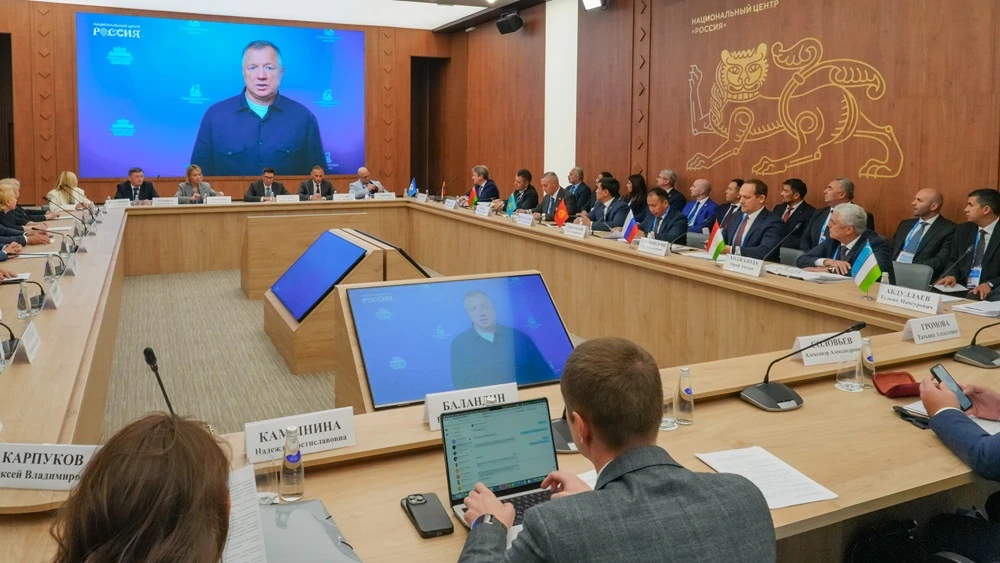
The 48th session of the Interstate Council for Geodesy, Cartography, Cadastre and Earth Remote Sensing of the CIS Member States was held at the National Centre RUSSIA in Moscow.

The "Nevalyashki" art installation by the National Centre RUSSIA consists of a single wave made up of 250 colourful nevalyashka (roly-poly) toys.


