


A scientist from Moscow State University, Andrei Konyaev, revealed the mathematical code of world art at the National Centre RUSSIA

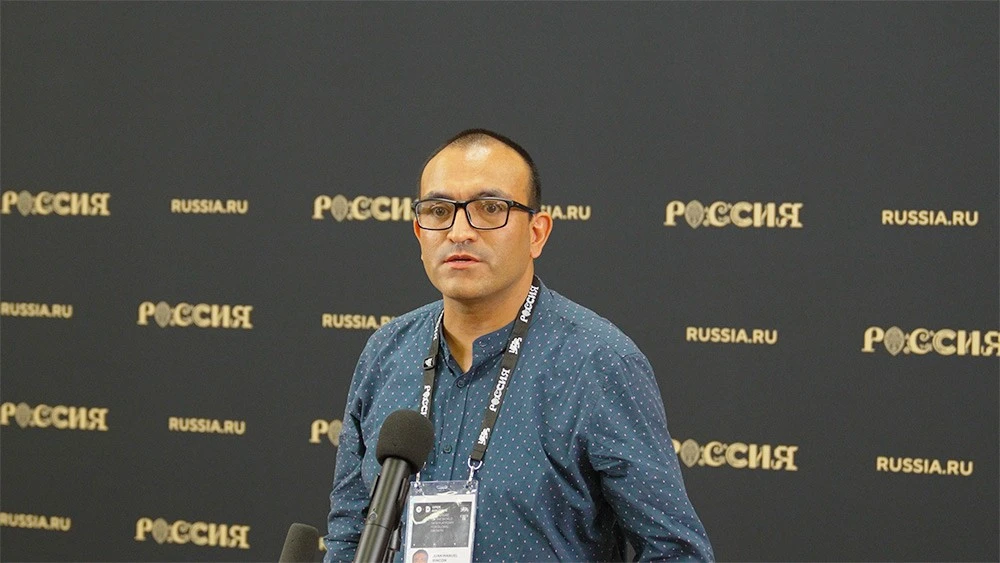
Mathematics is not just formulas and calculations, but a universal foundation on which world art has been built throughout history. This was shared during Russian Science Day at the National Centre RUSSIA by Doctor of Physical and Mathematical Sciences, Associate Professor of the Mechanics and Mathematics Faculty of Moscow State University, and publisher of the popular science online outlet "N+1", Andrei Konyaev.
From the very first minutes of his lecture-presentation "How Mathematics Creates Art", the expert jokingly warned the audience: "If a lecture contains at least one formula, it immediately cuts the number of potential listeners in half. I have a formula on almost every slide — and sometimes several at once." Yet behind the complex symbols lay the parallels Andrei Konyaev drew between science and creativity. To begin with, he demonstrated that musical notation is essentially a form of mathematics.
"A whole note is one unit, a half note is one half, a quarter note is one quarter. All of these are ordinary fractions that musicians use when writing music," Andrei Konyaev explained.

From fractions, the lecturer moved on to the physics of sound and the analysis of different musical tuning systems. In particular, he explained why the human ear finds harmonies with whole-number frequency ratios pleasing, and why musicians eventually had to abandon "natural" tuning in favour of tempered tuning.
"Just to understand how an instrument is tuned, people needed sines, cosines and exponentials. Where in everyday life do you encounter the square root of two apples? Nowhere. But the square root of two in retuned instruments appears all the time," Andrei Konyaev added.

The expert then explored in detail the connection between science and visual art. The audience learned what fractals in mathematics have in common with shikharas in Hindu architecture, semi-regular (Archimedean) tilings and girih patterns in Islamic decorative art, the Flying Dutchman from "Pirates of the Caribbean", and the Navier–Stokes equation. Using the golden ratio and Fibonacci numbers as examples, Andrei Konyaev showed how mathematics shapes harmony in painting, architecture, and even in nature itself.
"In a five-pointed star, the golden ratio appears at every step. And the so-called ‘golden spiral’, based on Fibonacci numbers, can be seen in seashells and in the structure of many Renaissance paintings. Paintings of that era were often built around a spiral: the beginning of the narrative is in the centre, and the development unfolds along the turns. All of this feels like magic, yet behind it lies pure mathematics," the scientist concluded.

Russian Science Day on 8 February at the National Centre RUSSIA brought together more than 2,000 scientists, experts and students from across the country. Throughout the day, they discussed how the scientific ecosystem functions today, where it is heading, and why scientists can be regarded as heroes of the new era. The programme included thematic sessions, lectures, and live discussions with experts.
The event was organised by the National Centre RUSSIA with the support of the Ministry of Science and Higher Education of the Russian Federation, the VCIOM Analytical Centre, and the Russian society Znanie.
A recording of the Russian Science Day livestream at the National Centre RUSSIA is available on the russia.ru website.
Event photobank



Geographer Alexei Vodorezov told guests at the National Centre RUSSIA why nature in Siberia and Alaska is so similar, and how this affected the dispersal of animals and humans.

From 1 to 10 May, the National Centre RUSSIA invites you to join the All-Russian campaign "Memory Wall".
The first performance of the musical and choreographic parable "Khorovod" at the National Centre RUSSIA was attended not only by bearers of Russian culture but also by foreign guests.


