

Youth Day opens at the National Centre RUSSIA as part of "Peoples of Russia" Week
How do
traditional values bring the peoples of Russia together, what do they mean to
young people, and what role do the state and society play in preserving them?
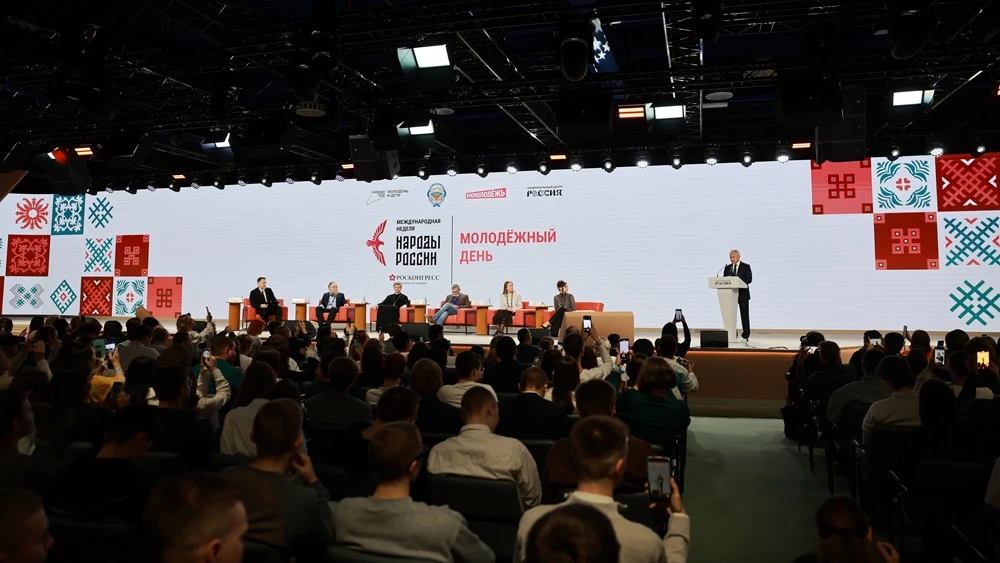
These questions were the focus of the panel session "Traditional Values as
the Foundation for the Development of Modern Russia", held on 7 November
at the National Centre RUSSIA as part of Youth Day at International Week
"Peoples of Russia". One of the session's key topics was the role of
the state and civil society institutions in preserving and strengthening
traditional values. The Secretary of the Security Council of the Russian
Federation, Sergei Shoigu, addressed the participants.
"I
welcome you to the main event of Youth Day, which is being held as part of
International Week 'Peoples of Russia'. It is particularly significant because
the President of the Russian Federation, Vladimir Vladimirovich Putin, has
declared 2026 the Year of Unity of the Peoples of Russia. Our country has
always been and remains a civilisation-state. Our strength lies in our
historical memory, spiritual traditions, cultural continuity and unity as a
multiethnic people. These values shaped Russian statehood over the centuries
and guide us today. Traditional values are no abstract formula. They are the
moral foundation of society. Presidential Executive Order No. 809 enshrines
these values, which include life, dignity, patriotism, service to the
Motherland, strong families, constructive work, justice, collectivism,
historical memory and the unity of the peoples of Russia," said Sergei
Shoigu in his welcome address.
He
emphasised that our ancestors had established these values and moral principles
over the centuries. They underpin our statehood, sustain every individual and
family, and shape our culture and sovereign worldview.
Alongside
the discussion of the work of the state and society, participants considered
the worldview that underpins Russian identity. The session explored the values
that have historically united the country's peoples. The Director of the Ivan
Ilyin Higher School of Politics, an education and research centre at the
Russian State University for the Humanities, philosopher and public figure
Alexander Dugin, outlined how Russia defines its place in the world, what
principles it draws on to assess events and what role history plays in this. He
compared Russia's path with those of the West and China.
"Russia
is a civilisation-state, and that is a very important statement. If we are a
civilisation-state, one crucial conclusion follows: we are not part of another
civilisation. We are a centre of civilisation, a centre of the world in a
sense. For us, the values of our tradition and history, our state, our culture,
our faith and our historical experience are the highest authority in deciding
what is good or evil, what is necessary or unnecessary, and what is permitted
or forbidden. Every civilisation has its own sense of time. In Western
civilisation, time is understood in terms of technological development moving
in a single direction. Chinese civilisation is different. It is highly
successful in technology, but its sense of time is cyclical. So, to understand
itself and rightfully become a fully fledged civilisation-state, Russia must
have a historical dimension of its own. History is more than the past. History
is our Russian time. It is the time of our civilisation, encompassing past,
present and future," said the philosopher.
The
discussion also examined how values are perceived in society today. Research
makes it possible to compare the views of different groups and identify issues
that call for a more focused discussion with young people. The Director General
of the VCIOM Analytical Centre, Valery Fedorov, described how the state's
approach to values has changed in recent years.
"The
state openly acknowledged that development is impossible without attention to
values, and that acknowledgement led to a systematic programme of work, from
policies on pupils' and students' personal development in schools and
universities to Executive Order No. 809 on traditional values. The results are
visible. Already, 58% of the country's adult population are convinced that
traditional spiritual principles should be followed whatever the circumstances.
Patriotism has taken deep root in our society. It does not need to be drummed
into people, and that is the clearest sign that these values are alive in them.
We still have a lot of work to do with young people aged 18–24. Today, 63% of
them choose flexibility over principles. That is precisely why events such as
Youth Day matter. They give us room to make progress and start a real
conversation about values," he explained.
Valery
Fedorov added that, according to a representative nationwide survey conducted
in July 2026, most adults believe people should remain true to traditional
spiritual principles regardless of the circumstances. He also presented
findings on how accurately people understand each of the 17 values set out in
the executive order, which values resonate most strongly with the public and
are best understood, and which principles shape the values of younger
generations.
Passing
values on to young people involves government and civic organisations as well
as spiritual mentors. Father Kirill (Sladkov), Rector of the Church of St
Nicholas in Pokrovskoye, Moscow, and Chair of the Youth Affairs Department of
the Moscow Diocese of the Russian Orthodox Church, took part in the session.
"When
we talk about Russia's spiritual path, I suggest looking at what faith has
inspired people to do over the centuries. What books did they write, and what
did they leave behind? How did they care for those who could not look after
themselves? What did they draw strength from when the country went through
difficult times? In troubled times, these become questions about our country's
future. It is easier for society to withstand hardship when people trust one
another, when they know that if they are in trouble, they will have someone to
turn to and can count on their support. That kind of trust takes years to
build. It depends on whether we keep our word in everyday life and continue to
treat others with respect in difficult circumstances," said Father Kirill.
He said the
way this experience is passed on to the younger generation is particularly
important. He recalled that at a meeting of the Supreme Church Council, His
Holiness Patriarch Kirill had called for close attention to what matters to
young people and what troubles them. In parish work, this means that young
people should have the opportunity to ask a question and mentors should have
the time to listen.
One
practical aspect of this work is preserving cultural diversity while
strengthening a shared Russian civic identity. The Director of the Federal
State Budgetary Institution "House of the Peoples of Russia", Anna
Polezhayeva, explained how ties between peoples are formed and why projects in
this field should be rooted in traditional values.
Another
aspect is the language used to discuss values in public. Maria Dudko, Head of
"Boundless", an agency that works with foreign bloggers, and Head of
the project "More Precious Than Gold", explained why the experience
of projects that engage with today's media and reach different audiences matters.
The
discussion brought together representatives of government bodies, civic and
religious organisations, researchers and creators of educational projects. It
focused on traditional spiritual and moral values as the foundation of the
worldview that shapes Russian identity, and on their significance for the
country's future. Television presenter and public figure Ruslan Ostashko
moderated the session.
Youth Day
at International Week "Peoples of Russia" was organised by
Rosmolodyozh as part of the Year of Unity of the Peoples of Russia. Its
programme brought together business, cultural and sporting events and
expositions at the National Centre RUSSIA, along with regional events and an
online campaign. These activities aim to strengthen a shared Russian civic
identity and interethnic harmony among young people.
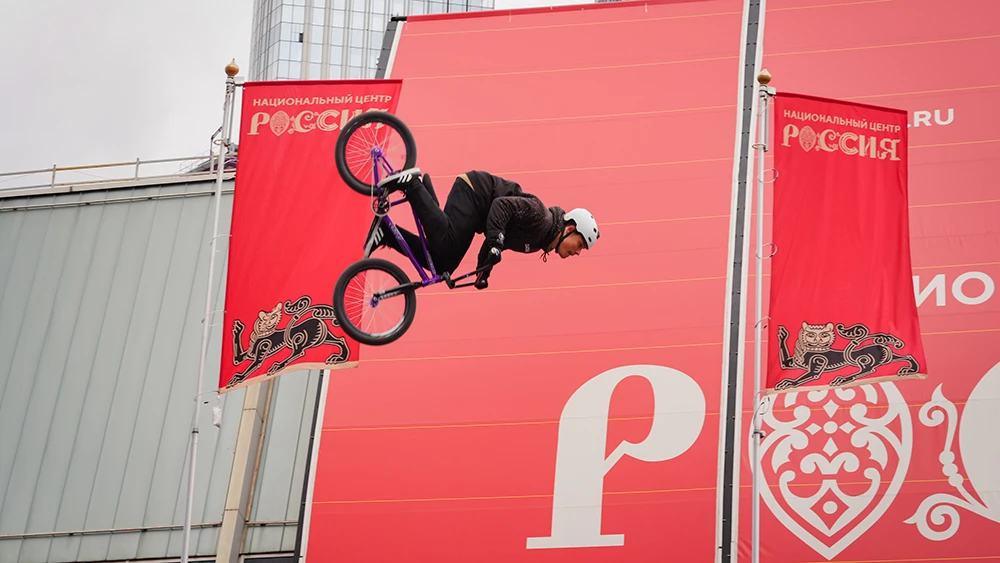
The outdoor area hosted the festival "809 — Our Cultural Code" as part of Youth Day at International Week "Peoples of Russia".
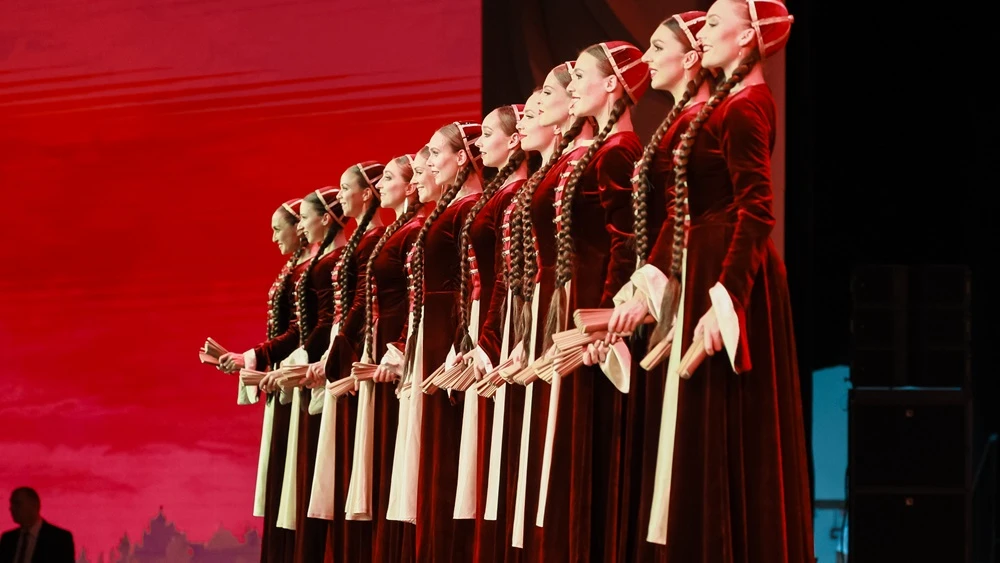
The audience saw vibrant performances that brought together folk traditions, expressive choreography and music from different countries.
"The Nature of Values" is a series of podcast interviews about how human and cultural values take shape and change.


