


Chronicle carved in stone: historian Yelena Levanova explains how the ancient artists of Chukotka created a "timeline of events"

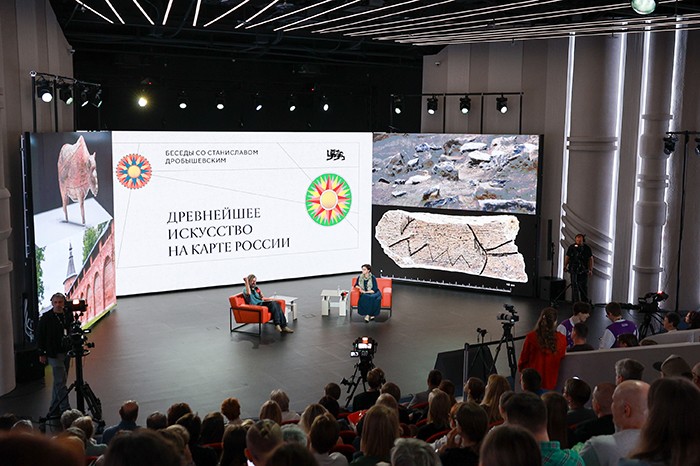
Ancient rock art can be found even in Russia's Far North. Our creative ancestors who lived beyond the Arctic Circle did far more than simply decorate the rocks out of fun: they created what could be described as family albums and even the prehistoric equivalent of today's social media feeds.Visitors to the National Centre RUSSIA learned about one of Chukotka's most remarkable archaeological sites — the Pegtymel petroglyphs — from Yelena Levanova, Candidate of Historical Sciences, Head of the Centre for Palaeoart at the Institute of Archaeology of the Russian Academy of Sciences, and Associate Professor at the Yuri Knorozov Mesoamerican Centre of the Russian State University for the Humanities.
"The petroglyphs in Chukotka are thought to be between one and one and a half thousand years old. They exist in only one location — along the lower reaches of the Pegtymel River, not far from the Arctic port city of Pevek. Thanks to geologists who first discovered them, they were noticed and documented. These monuments were created by tundra hunter-artists who hunted reindeer, polar bears, whales and other marine mammals," Yelena Levanova explained.
According to the historian, the site's greatest fascination lies not only in the artistic quality of the carvings but also in their content. She suggested that the people who created them — probably not the Chukchi — used the kilometre-and-a-half-long rock face as a kind of visual chronicle of their lives, recording events much like a modern news feed.
"The entire chronology of life is here: grandmother is born, grandfather is born, father goes hunting in the taiga, here is one reindeer, here is another, a pregnant doe, umiaks, kayaks, and so on. In many ways, it resembles today's social media, where people share everything that matters to them. It's like a family album stretching for one and a half kilometres, telling the story of several communities that must have met here for celebrations or other shared activities. Many different artists worked on these carvings. Some created astonishingly realistic romantic reindeer, rhinoceroses and other animals with beautifully proportioned forms, while others produced much simpler triangular figures, clearly carved by someone with less artistic experience," she said.
Among the most recognisable images at Pegtymel are figures of women wearing tall headdresses, often referred to as "fly agarics" because of their mushroom-like appearance. Yelena Levanova explained why these images continue to spark debate among researchers.
"You can clearly see that this is a woman here — her hips, breasts, earrings and tall headdress are all visible. Among the Aleut peoples and particularly later Greenland Inuit and the peoples of Russian America, there are similar depictions of noble women wearing elaborate hairstyles and hairpieces. There are also male figures with mushroom-shaped heads, and some female figures whose legs merge into what looks like the stem of a mushroom. Many ethnographers would like to interpret these figures as mushroom spirits, since the mushroom cult has long existed among the Chukchi and remains part of their culture today. So the 'fly agarics' remain an open question," Yelena Levanova concluded.
Yelena Levanova spoke at the National Centre RUSSIA as part of the
"Conversations with Stanislav Drobyshevsky" series. This educational
series is a signature project of the National Centre RUSSIA; it introduces
visitors to the country's rich historical and anthropological legacy while
showcasing the latest discoveries in these fields.
Event photobank




The Deputy Prime Minister emphasised the need to integrate all modes of transport, including making greater use of railways for passenger services.


