


Alexei Kozyrev discusses the predictive role of philosophy at the National Centre RUSSIA
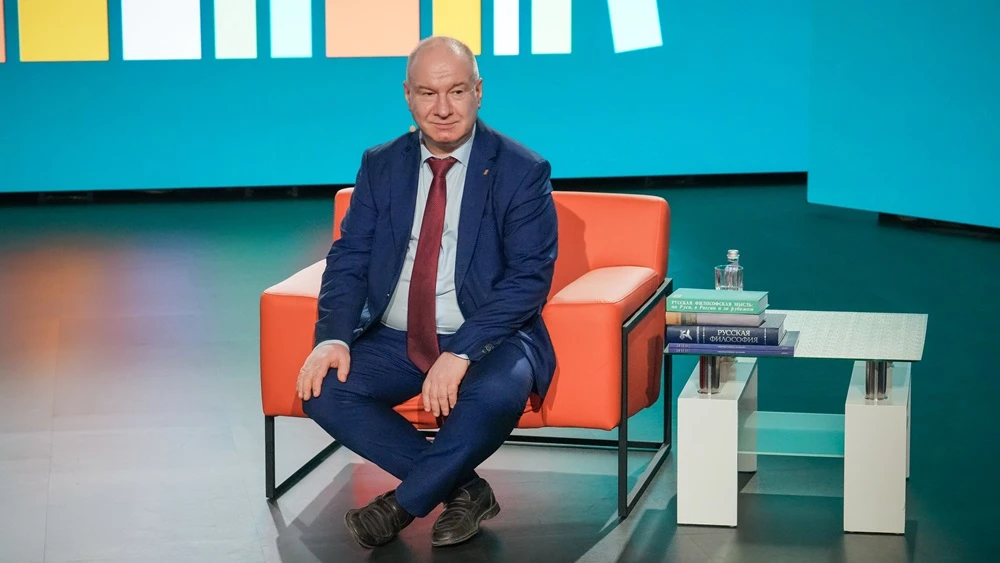
Can philosophy predict the future, and should it? At a meeting of the Literary Club "What to Read?! Meanings" at the National Centre RUSSIA, Dean of the Faculty of Philosophy at Moscow State University Alexei Kozyrev admitted that the question of what the future might look like could well be added to philosophy's central question about the meaning of life. However, he noted that philosophers primarily work with cultural material whose roots extend deep into the past.
"I think that a philosopher's primary task is not to reflect on contemporary trends in themselves. A philosopher reflects on the realms of culture, on the material that reaches the present but has foundations extending deep into the past, like a pyramid. That is why it is difficult to tell a philosopher: 'Be a philosopher of the future.' But there is another type of thinker — philosopher-prophets. Konstantin Leontiev, for example, Dostoevsky in a certain sense, and to some extent Solovyov as well — we need only recall his 'Three Conversations on War, Progress and the End of World History'," explained Alexei Kozyrev, Dean of the Faculty of Philosophy at Moscow State University, Head of the Department of the History of Russian Philosophy and Candidate of Philosophical Sciences.
At the same time, according to the expert, philosophy should not be reduced to carrying out government commissions or constructing a vision of the future "on demand". He recalled a conversation he had many years ago with a representative of the Presidential Executive Office of Russia, who remarked that the authorities were interested in only a small part of what philosophers worked on — political philosophy, the philosophy of history and the understanding of contemporary processes.
"There is some truth in that. The authorities are entitled to expect responsible and considered statements from philosophers, including forecasts. Not in the sense that this is necessarily what will happen, but that this is what could happen. So one of the functions of philosophy is to anticipate, to warn and sometimes even to predict. But philosophy as a whole cannot be reduced to this," Alexei Kozyrev concluded.
The Literary Club "What to Read?!" is an original project of the National Centre RUSSIA. It is a space for dialogue about reading culture and the public discussion of important contemporary issues. Participation in the club's meetings is free with advance registration on the russia.ru website. The latest event schedule is available in the "Events" section.


On 15 September, a 558-square-metre children's playground inspired by Dymkovo toys opened in Yekaterinburg's Preobrazhensky Park.


