Four centuries of history: Kirov folk craft presented at trade fair in Uzbekistan
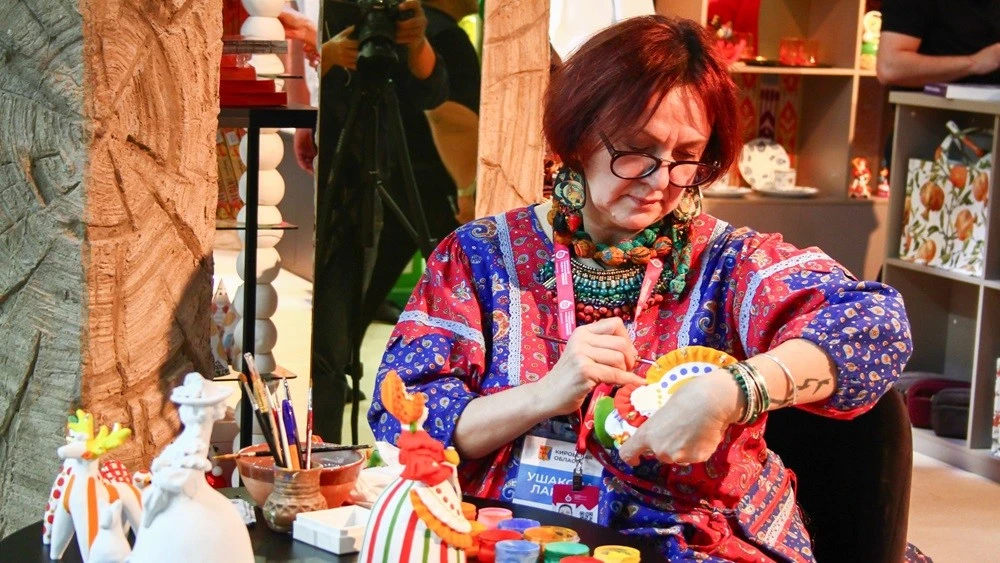
The International Industrial Trade Fair "INNOPROM. Central Asia" has opened in Tashkent. At the stand of the National Centre RUSSIA Department Store, a demonstration of Dymkovo toy painting took place. Guests of the event learned how one of Russia's most famous and recognisable folk art crafts is preserved today in the Kirov Region.
The Dymkovo toy is a craft with a history of more than four centuries. Its homeland is the ancient settlement of Dymkovo (now part of Kirov) in Vyatka. The first products were whistle toys made for the annual spring festival "Svistunya" (Whistler). In the summer, entire families in Dymkovo would extract and knead red clay, manually grind chalk, and from autumn until spring, they would mould, dry, and fire the toys. Closer to the festival, craftsmen would whiten them with chalk diluted in cow's milk, paint them, and decorate them with diamond shapes of gold leaf. Over time, stable themes, images, and an expressive artistic language of the craft emerged — with pure, saturated colours and a recognisable pattern.
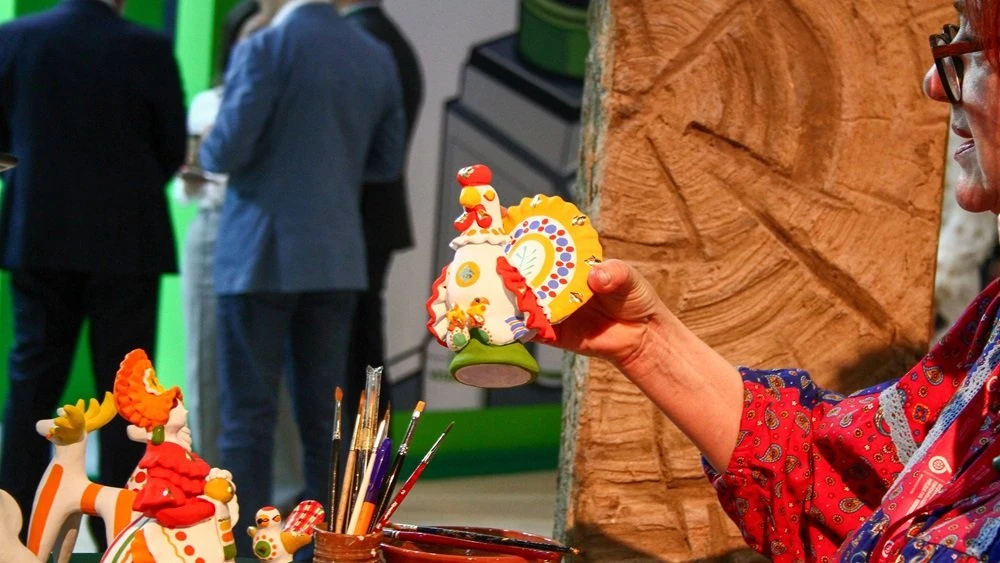
At the stand of the National Centre RUSSIA Department Store, the leading craftswoman of the industry, a member of the Russian Union of Artists, Larisa Ushakova, conducted a demonstration workshop. She showed the painting stage of an already prepared toy and spoke about the specifics of the craft. Guests learned how the craft has changed and why, despite technological development, it remains handmade.
"It would seem that today, in the age of electronics and mechanics, it would be logical to simplify everything and put it on a conveyor belt. But if we remove manual labour, the main thing — the living energy of the master — disappears. The whole charm of the Dymkovo toy lies precisely in this conventionality, in the minimalism, in the fact that each element of the painting is thought out and carries meaning. We try to preserve this authenticity, not to turn the craft into just a 'beautiful souvenir'," emphasised Larisa Ushakova.
The master explained in detail that the language of the painting originates from traditional Russian costumes, where ornaments were not only decoration but also amulets: "Each element of the painting is not just a decoration. Stripes, paths, grids with dots — all this came from folk costume. Previously, such patterns were embroidered on clothing for different events: one costume for the newlyweds, another for the birth of a child. Each sign worked for prosperity, for protection from something negative, for health, for love. When we draw a path — it's a road, a journey. A grid with dots is a sown field, a symbol of the future harvest. We have transferred these elements to the painting of the Dymkovo toy, and behind the bright pattern there is always a story and a protective function."
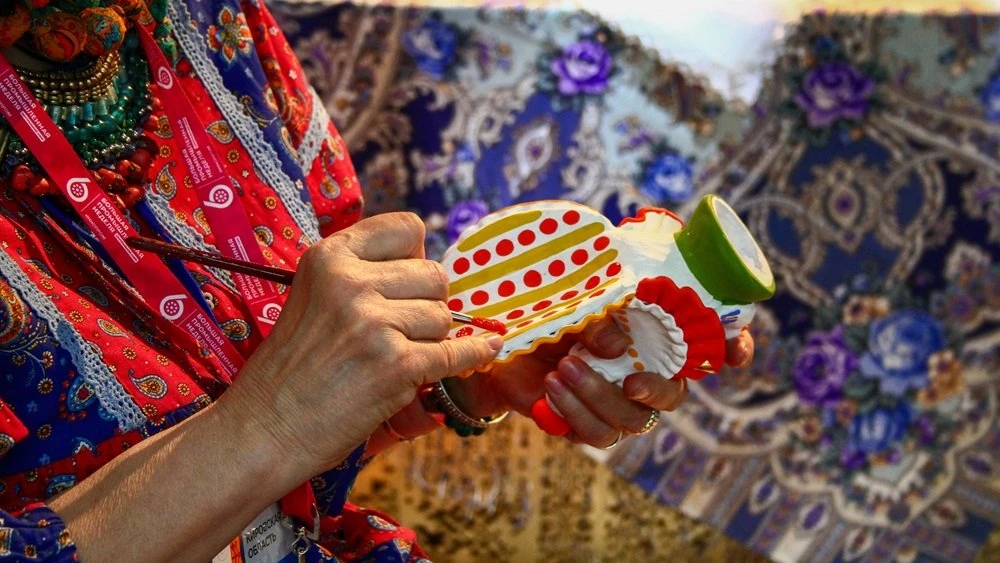
During the demonstration, guests saw how a composition is born on a white base: colour spots are lined up, stripes and geometric figures appear, gradually forming a recognisable image. Larisa Ushakova noted that from the outside, this might not seem too complicated. But in reality, it requires serious training. According to the master, the girls who come to learn spend the first few years mainly studying the history of the craft, understanding the ornaments and their meanings, and learning to feel form and colour. Only then do they move on to full-fledged painting. This is precisely how the centuries-old traditions of creating the Dymkovo toy are preserved.
"The craft has already gone through difficult times — both in the 1990s and the 2000s. Our grandmothers and masters of past generations did everything possible to preserve it and pass it on. I would very much like to believe that the Dymkovo toy will live for another hundred and two hundred years. Fortunately, young people are interested, they come to us with genuine interest — and it is they who become the next guardians of the tradition," the expert explained.
The demonstration of Dymkovo toy painting became part of the events programme of the Department Store of the National Centre RUSSIA at the "INNOPROM. Central Asia" trade fair, which opened on 20 April. For the first time in its history, the National Centre RUSSIA is taking part in an overseas event and presenting there one of its flagship projects — the Department Store RUSSIA. The stand of the Department Store is dedicated to the image of the merchant class — a symbolic intertwining of cultures and peoples. The design of the space conveys the richness and diversity of the cultural heritage of Russia's regions and emphasises the closeness of the traditions of Russia and Uzbekistan.
A central place in the exposition is occupied by an exclusive nevalyashka (roly-poly doll), whose painting is based on a traditional Uzbek costume. This image combines historical motifs, folk art, and contemporary design, thus reflecting the key idea of the project — dialogue of cultures through objects.
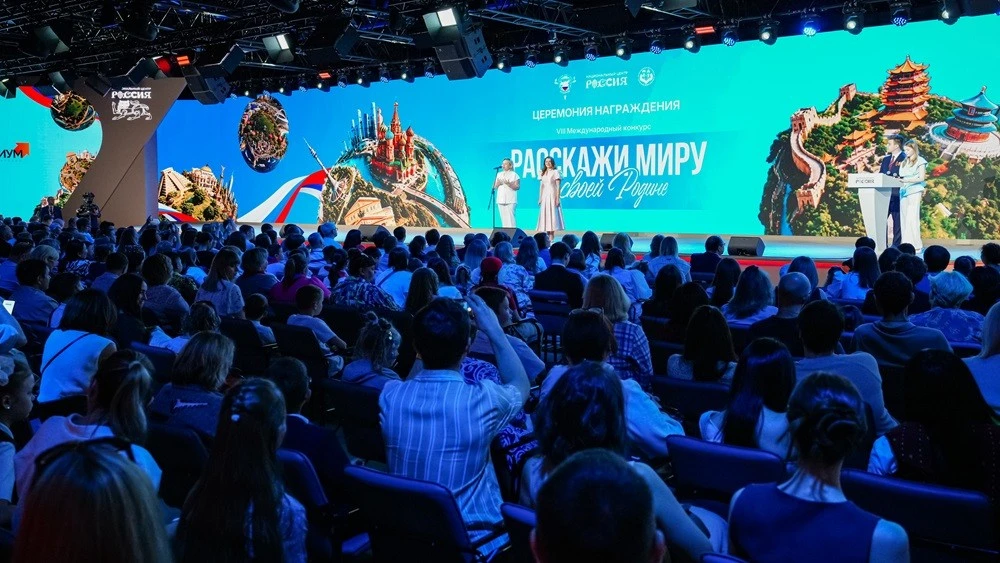
The contest gave young talents an opportunity to share interesting facts from the history and culture of their small homeland.

The participants discussed how content plans work in new media, which formats help retain an audience and how platform algorithms operate.