


How fur ornament is born: traditions of the Khanty and Mansi peoples presented in Tashkent
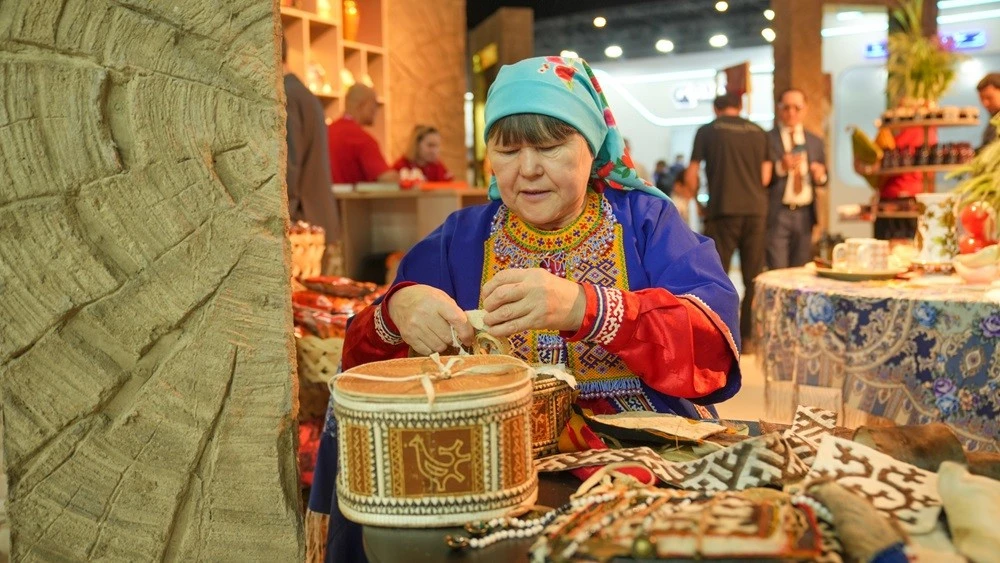
At the stand of the National Centre RUSSIA at the international industrial trade fair "INNOPROM. Central Asia" in Tashkent, guests were able to see a rare northern craft — the sewing of a fur bag with ornamentation according to the traditions of the Khanty and Mansi peoples. Craftswomen from the Khanty-Mansi Autonomous Area — Yugra demonstrated how not just a bag, but an important part of the traditional way of life, is born from reindeer hide.
The work was carried out by masters Maria Igisheva and Yelena Fedotova. They presented the process of creating a tuchan khir — a small fur bag for needlework. First, guests were introduced to the basis of the craft — the manual currying of reindeer hide. The craftswomen explained how important it is to properly prepare the material so that it is both strong and flexible, and can serve for many years in harsh northern conditions. An ornament is assembled from strips of white and dark fur, which is then sewn with threads made from reindeer sinew. Each strip, each corner of the pattern has meaning: its strict geometry, its contrasting colours, and its clear rhythm of lines. A simple bag gradually becomes part of the cultural code, preserving the knowledge of generations.
"The culture of the Khanty and Mansi is closely linked to the traditional way of life. All these items — bags, clothing — were always sewn primarily for the family: for warmth, for beauty, for everyday life. They were not made specifically 'for sale'. Every craftswoman first makes clothes for herself, her husband, her children, her daughters. The work is enormous, but that is precisely how the living tradition is preserved," said Yelena Fedotova, a representative of the indigenous peoples of Yugra.
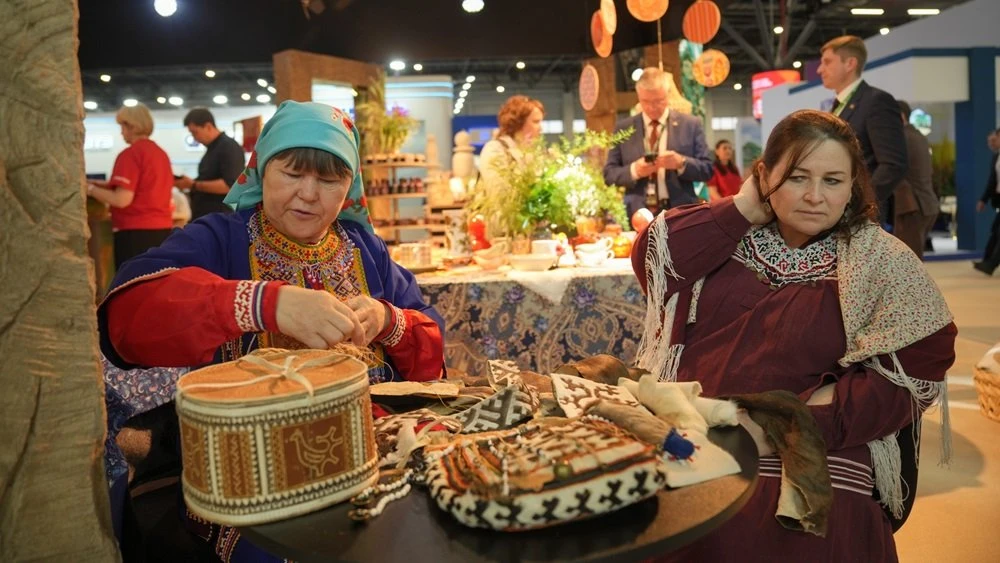
Guests not only observed the process but also asked the craftswomen about the meanings and the everyday life of the Khanty and Mansi peoples. Maria Igisheva and Yelena Fedotova explained that bags for these peoples were never 'just things'. In conditions of constant moving — from winter camps to seasonal grounds — the way of these peoples’ life required a very clear organisation of everyday routine. Each item had its place and function, and bags differed in shape, size, and decoration depending on their purpose.
"Our task is to preserve this ancient art of working with natural materials. And it is very important that the National Centre RUSSIA supports us in this," emphasised Yelena Fedotova.
Fur bags for needlework, travel bags, and bags for storing small items were all made with great attention to aesthetics. The ornament helped not only to decorate the item but also to 'attune' it to its owner, connecting the person with their kin, with the land, and with the animals that provided the fur and hide.
The demonstration was part of the programme prepared by the Department Store of the National Centre RUSSIA, which is being presented abroad for the first time. It brings together products from dozens of Russian manufacturers — from gastronomy to folk crafts — and each presentation turns into a living narrative about the culture and traditions of the country's regions.
The "INNOPROM. Central Asia" trade fair is taking place in Tashkent and brings together participants from many countries. For international guests, getting acquainted with the fur mosaic of the Khanty and Mansi was an opportunity to see a living tradition and understand how, thanks to dedicated enthusiasts, ancient northern crafts continue to live on in the 21st century.

The international exposition-forum ARCH MOSCOW will open at Gostiny Dvor (the Old Merchant Court) on 27 May.

Through the digital platform, young people from across the country will be able to tell stories of these heroes in short video formats.

The meeting focused on generating concrete proposals and collaboratively developing initiatives.


