


Dialogue with the world and principles of foreign policy: Maria Zakharova speaks at the National Centre RUSSIA

How does the Russian Federation build dialogue with the
world? What position it holds on the international stage, and what qualities of
a people's diplomat one needs to possess to contribute to the formation of a
multipolar world? Maria Zakharova, Director of the Department of Information and Press and official Spokeswoman of the Ministry of Foreign Affairs of Russia, answered
these and other questions at the National Centre RUSSIA on 9 December.
Before talking with the guests, Maria Zakharova
congratulated all those in attendance on Heroes of the Fatherland Day. She
reminded the audience that this year is an anniversary — the 80th anniversary
of the Great Victory: "This is an important day when we honour the
defenders of the Fatherland. We have dates and holidays when we remember
heroism. These are, undoubtedly, 9 May, 12 June — Russia Day. But how can we do
without heroes? <...> We have so many heroes, selfless people who are
ready to come to the aid of others, both by the call of the times and by the
call of their own hearts, and to show their best qualities. Therefore, this is
an excellent initiative, and a wonderful, remarkable holiday. Let us fill it,
on our part, with interesting thoughts and ideas."
The address by the Russian Foreign Ministry
spokesperson was held in a question-and-answer format. For instance, Maria
Zakharova was asked about her vision of the future of the country's foreign
policy in the face of global change and challenges.

"This question is primarily institutional in nature,
and here, in my opinion, it's important to speak not so much about personal
perception as about the official position. Given that I officially represent
the Ministry of Foreign Affairs, we must, of course, first and foremost refer
to documents. In 2023, a new Concept of the Foreign Policy of the Russian
Federation, developed in an interdepartmental format, was made public. This is
the very document that defines our country's approaches to implementing its
foreign policy course, and therefore — to international relations,"
answered Maria Zakharova.
She noted that the document is unique because it does not
merely describe the goals and objectives of foreign policy for the future but
also captures a "new historical moment." According to her, the
Concept combines a programme of specific steps and actions and declares the
postulates and values that are important today for Russia and its population.
Maria Zakharova emphasised that after the First World War,
humanity realised the inadmissibility of a number of inhumane practices,
including the use of poison gas. It formed the foundations of humanitarian law,
and began to contemplate the principles of mercy in war. However, the Second
World War became unprecedented in scale and brutality, when the goal was the
mass destruction of civilians. It shocked the whole world and led countries and
peoples to decide to unite and create an international security system in the
form of international law and the United Nations. She added that for decades
this "safety net" kept the world from a new global catastrophe, but
over time it became noticeable that a number of states began to deviate from
the principles and agreements embedded in this system.

"About seven years ago, we began to meet a new term
that became actively used in the West: 'Rules-based order'. That is, instead of
'international law' or 'the international legal system', these new words began
to appear <...> We began to analyse, to clarify: what is this anyway?
What does this new definition stand for? Why did the old phrase cease to satisfy?
And it turned out that, as in the well-known expression, 'the crux of the
matter' was precisely here. Here we met the new state of affairs" she
continued.
Maria Zakharova explained that, in fact, these rules turned
out to be the "law of the jungle": the stronger party dictates its
terms and manages the situation. Therefore, she said, a major question is
whether international relations will be based on laws on which law enforcement
practice can be built, or whether it will be the same old "story of the jungle."

"We were told that somewhere there is a 'beautiful garden', as the European Union expressed it <...> and everything else is supposedly the jungle. We disagree with this. And that is why there is now a struggle — a struggle on all fronts — over what kind of world it will be. Will it be a world of a 'wild order', where only a smaller part of humanity will have the right to resources, education, medicine, healthcare, human rights <...> and everyone else will simply be in the position of a servicing majority? Or will we still live by law — by written law and by God's law, because both are critically important for humanity?" Maria Zakharova asked.
One of the most interesting questions posed to Maria Zakharova was whether a person whose professional activity is not related to diplomacy or international relations can contribute to the formation of a multipolar world.
"Of course, everyone can serve their Motherland without
being in state or military service <...> And, very importantly, to also
serve a world order that should still be based on international law. And here I
have no doubts, everyone can. The question remains only in your personal
qualities, because without them, you won't get far either. Which world will you
stand for? Will you strive for justice? Will you defend the values that are
basic and fundamental not only for our country but for all humanity? Or will
you profess some other approach?" answered the official spokesperson for
the Russian Foreign Ministry.

Another question was asked about what skills are necessary
to become a people's diplomat. In particular, what qualities might be useful in
life, what useful things one needs to master, and what else will help in life.
"You need to learn languages; it is a must. Even if by
self-study, no matter how — they must be learned. It is very useful, even if it
is not directly needed. You need to know the subject. What might be interesting
to the other side? For example, memorial topics — with some countries, with
some peoples — here we can find common ground. For some, their shared history
is a complicated matter, but even here one can find points of contact. Also,
there are culture, art, and literature which are important too, despite the
attempts to 'cancel' us now — this wave will pass anyway. Precisely because of
that, art and culture will always be a topic of interest for communication, for
exchanging experiences, for finding common ground. A museum is another sphere
where you can realise yourself, create some joint project and find common
ground," Maria Zakharova is convinced.
Maria Zakharova's address took place as part of the business
programme of the Russian society Znanie at the All-Russian Patriotic Forum. The
forum is organised by the Rospatriotcentre of Rosmolodezh. The event is
dedicated to Heroes of the Fatherland Day. The forum involves more than 4,000
young people from across the country. Over three days (7 to 9 December),
government officials, Heroes of Russia, participants in the Special Military
Operation, and military correspondents will talk about heroic deeds, personal
experience, and the role of citizens in the country's development, and will
also answer visitors’ questions.

8 June is a maintenance day at the National Centre RUSSIA.
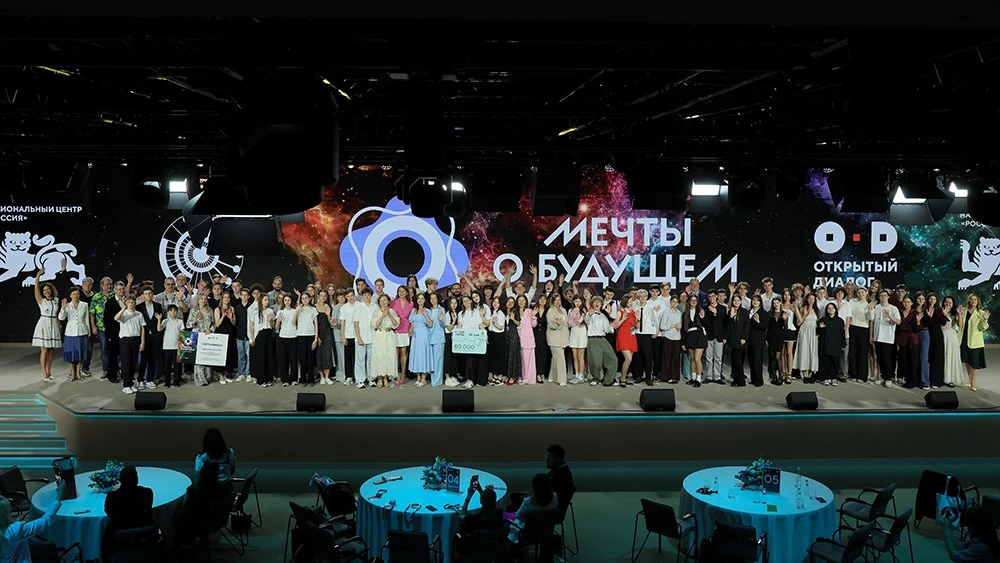
Seven teams from Russian regions and the near abroad were named winners and runners-up of the II Video Essay Contest "Dreams of the Future".
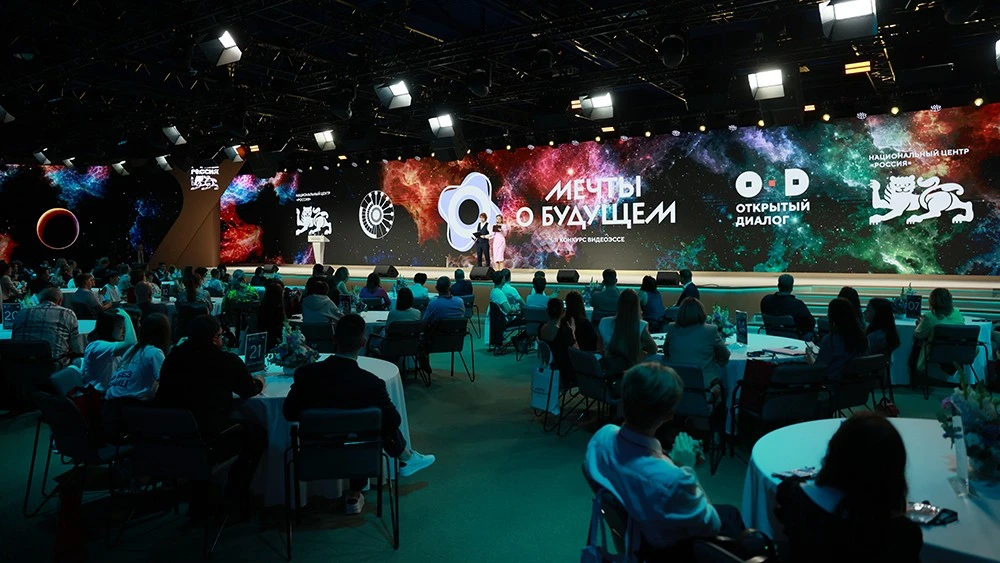
The II Video Essay Contest "Dreams of the Future" is being held at the National Centre RUSSIA on 7 June.


