Art as a way of reaching understanding: Stanislav Drobyshevsky on the link between creativity and the development of communication in the ancient world
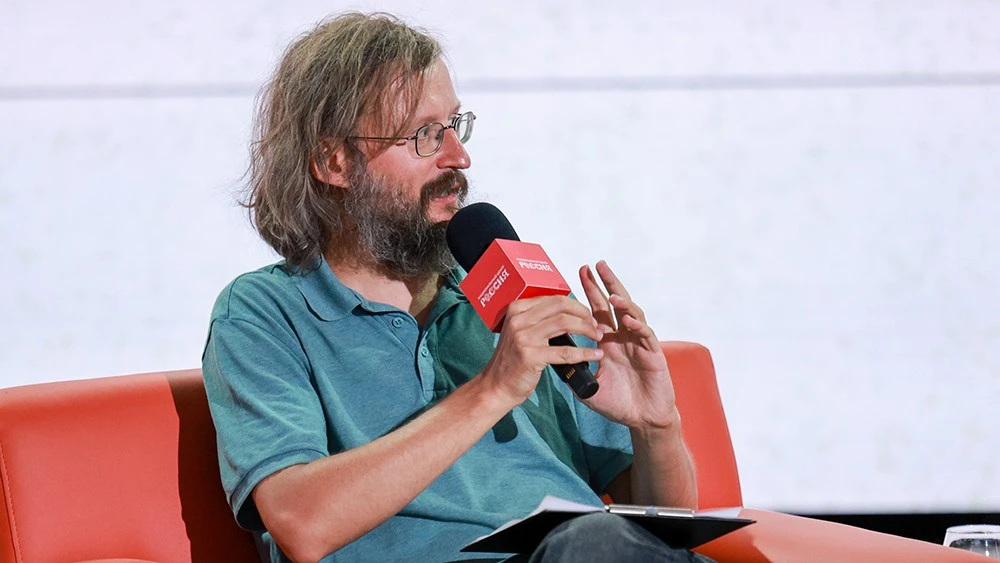
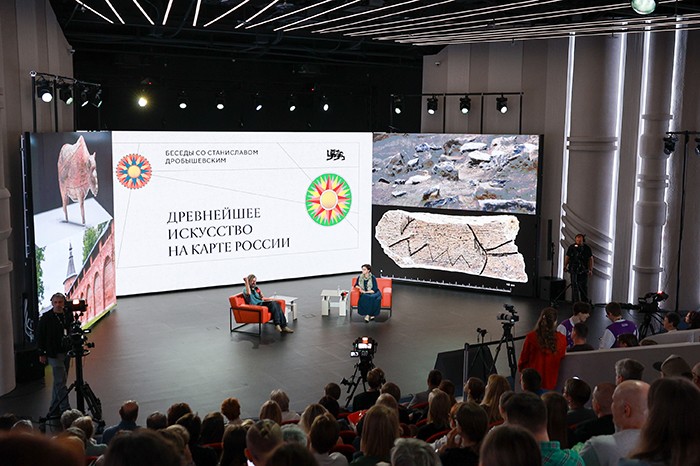
The evolution of the earliest forms of art was closely connected with the development of communication among our distant ancestors. This was the subject of a talk delivered at the National Centre RUSSIA on 19 June by Stanislav Drobyshevsky — Candidate of Biological Sciences, anthropologist, Associate Professor at Lomonosov Moscow State University, co-founder of the Anthropogenesis.ru portal and founder of the science popularisation movement "Drobyshevsky's Projects" — as part of the "Conversations with Stanislav Drobyshevsky" series.
The anthropologist suggested that Neanderthals, although potentially capable of creating the earliest works of art, were not actively engaged in artistic activity because they lived in isolated groups and had little need to communicate with neighbouring communities.
"After a small scratched drawing — the world's only known Neanderthal drawing — was discovered at the ancient site of Khotylevo, we learned that these people were physically capable of creating art. However, they apparently felt little need to do so. This was probably because Neanderthals lived in very small and isolated groups. They had no need to prove anything to one another. When you live in a group of twenty-five people and see the same faces from birth to death, there is little need for symbolic communication," Stanislav Drobyshevsky explained.
According to him, this relatively passive attitude towards creativity sharply distinguishes Neanderthals from more "modern" ancient human species. As evidence, Drobyshevsky cited Khotylevo-2, a Cro-Magnon settlement belonging to the Gravettian culture. Archaeologists discovered a large number of ancient artistic objects there, including figurines, a ritual complex, decorated staffs and many other artefacts.
"At that time, Homo sapiens lived in Africa, where resources were far more abundant and contact between less familiar groups was much more frequent. Constant conflict with neighbours is not advantageous — sooner or later, you will simply be killed. It is far better to learn how to reach agreements, and art may have become one of the ways of doing so. Perhaps this is why that little scratched drawing appeared at Khotylevo. Neanderthals came there to make tools from the local flint. Most likely, groups from different areas gathered there, meaning that people who did not know each other particularly well met in one place. It is precisely in such situations that art emerges. Among Cro-Magnons, we find a vast number of similar objects," the expert concluded.
"Conversations with Stanislav Drobyshevsky" is an original educational project of the National Centre RUSSIA, with Russian anthropologist Stanislav Drobyshevsky serving as host. The initiative aims to introduce audiences to Russia's unique historical and anthropological legacy, highlight the latest discoveries in these fields, and broaden public understanding of the distinctive characteristics of the country's regions. The first event in the series, entitled "The Earliest People of Siberia", was held at the National Centre RUSSIA on 14 April.