


Holidays on Mars, living cities and family warmth: "Dreams of the Future" contest shows how schoolchildren see the world in half a century
Knowledge
is uploaded directly into the brain during lessons, living houses regulate
lighting by themselves, and a quantum communicator makes it possible to talk to
relatives on Mars — young people’s fantasies about the future are truly
boundless. At the same time, teenagers are confident that no technology can
replace family warmth and the joy of true friendship. How young people aged 12
to 18 imagine the future was explored by the organisers of the 2nd Video Essay
Contest "Dreams of the Future" at the National Centre RUSSIA ahead of
Children’s Day.
In total,
schoolchildren from all 89 regions of Russia, as well as from 10 republics of
the near abroad, shared their dreams of the future: Uzbekistan, Belarus,
Tajikistan, Kazakhstan, Kyrgyzstan, Moldova, Armenia, Azerbaijan, Turkmenistan
and the Pridnestrovian Moldavian Republic. The total number of applications
submitted was 935.
The future
is people
As it turned out, in almost all regions, young people dream
of preserving humanity in the era of supertechnologies and artificial
intelligence. Schoolchildren take as their examples the perfect universe of
Ivan Yefremov’s "Andromeda Nebula", the humanistic "Noon
Universe" of Arkady and Boris Strugatsky, and the hospitable high-tech
Moscow of the late 21st century, where Kir Bulychev placed his heroine Alisa
Selezneva.
In their
fantasies about a harmonious future, the ideas of young people from different
corners of the country are strikingly consonant. From Kaliningrad to Chukotka,
schoolchildren dream of the world becoming quieter and safer, of smart machines
taking over all routine work, and of people having enough time to communicate
with one another.
According
to young people, technological development does not divide people, but brings
them closer together: a grandmother can attend a family dinner as a hologram, a
quantum communicator provides a connection with residents of Earth colonies on
the Moon and Mars, and a built-in translator helps people understand anyone
(and, if the settings are adjusted, even a representative of an
extraterrestrial civilisation!). And no advanced simulator can replace real
impressions — a birthday cake baked with one’s own hands, even if slightly
burnt, and living friends are still better than a perfect celebration based on
a script written by a neural network.
Our space
Space is a
topic that especially concerns dreamers from the Altai, Trans-Baikal, Krasnodar
and Primorye Territories, the Arkhangelsk, Kaluga, Kirov, Novosibirsk and Penza
Regions, the Donetsk People’s Republic, the Lugansk People’s Republic and the
Republic of Mari El. It is in these regions that young people think most about
conquering the galaxy, contact with extraterrestrial civilisations, and the
idea that space is a test not only of resilience, but also of humanity.
Schoolchildren
hope that in the future, humanity will be able to fly to any planet and create
oases of life on Mars and the Moon. But with the development of long-distance
crewed flights, it is more important than ever to preserve the ability to
empathise and the readiness to help in a difficult situation. And even among
the cold stars, to remember home.
Children of
nature
Harmony
between nature and technology is the dream of young people from the Vologda,
Voronezh, Lipetsk and Sverdlovsk Regions, the Kamchatka, Stavropol and
Khabarovsk Territories, the Karachayevo-Circassian Republic, the Chechen
Republic, Sevastopol and the Yamal-Nenets Autonomous Area. In these regions,
there are especially many young people who think about preserving the planet.
Fortunately, teenagers look to the future with considerable optimism.
In young
people’s imagination, the world of the future is a space where technologies are
inspired by nature rather than destroying it. In their fantasies, living houses
grow, regulating lighting and temperature by themselves and possessing the
ability to heal their own damage through symbiosis with bacteria. Employees
work in farm offices at computers based on mycelium, while hardworking drones
perform hundreds of useful tasks: pollinating flowers, collecting rubbish and
filtering water.
Science
unites
Science as
humanity’s superpower — this is the dream shared by young people from the
Jewish Autonomous Region, the Kaluga, Kostroma, Kursk, Orenburg and Pskov
Regions, and the Republic of Sakha (Yakutia). They hope that in the future,
people will learn to cure all diseases, grow new organs and limbs, and find a
recipe for prolonging youth. However, teenagers look at the probable future
very practically and know for certain that people will have to unite to solve
tasks of universal importance.
According to young people, science should become a universal
language uniting scientists from all over the world. An interdisciplinary approach and constant
exchange of knowledge are the only way to solve global problems such as
pandemics, weather anomalies, serious diseases and environmental pollution.
Dreams as
legacy
Some of
teenagers’ fantasies will surely come true in the coming decades. History shows
that this always happens. For example, today’s teenagers live in a world their
peers in the 1960s and 1970s passionately dreamed of. Here is a striking
example: in 2000, a "time capsule" was opened at Artek — a letter
from pioneers written in 1960 and sent into the future. In it, the young people
described their vision of the year 2000: people fly to the Moon, and Artek has
its own cosmodrome. Well, reality has come very close to those fantasies:
construction of an inhabited lunar base is planned for 2030, and this year, as
part of the "First Space" programme at Artek, children may not have
launched from a cosmodrome, but they did create models of hydropneumatic
rockets and antennas for receiving space data, as well as learn about
spacecraft onboard systems.
Pupils of
School No. 25 in the city of Orsk also left letters for future generations in
1972. Their dreams included large televisions in classrooms, broadcasts from
other planets and meetings with people who had visited Venus and Mars. How
delighted they would be to see interactive touch panels in modern schools and
to learn that test cosmonauts regularly speak with young people at educational
events, often directly from aboard the International Space Station!
A dream can
be captured not only in words, but also in colour. Young authors of the
postcard set "We Will Conquer Space. Drawings by Soviet Children"
(1962) and participants of the third International Young Artist Contest (1982)
drew their visions of the future. The theme of that year’s contest was "On
Earth and in Space". The children’s creativity is full of optimism:
Earthlings conquer outer space, make friends with alien creatures and even hold
bicycle races on Saturn’s rings. One of the contest participants called her
work "Into Space So That Earth May Bloom" — and indeed, why else set
out for the stars, if not for the prosperity of one’s home planet? In this
sense, modern teenagers are no different from their predecessors: for them,
space is not a backup place to live, but a source of new knowledge and a way to
expand their picture of the universe.
Soviet
teenagers dreamed of seeing themselves in the place of the heroes of science
fiction films such as "Guest from the Future", "Moscow —
Cassiopeia", "Teens in the Universe" and "The Big Space
Travel". Their plots are different, but their interpretations of the
future are similar: technological development makes it possible to travel not
only through space, but also through time; special devices make it possible to
read the thoughts of people and animals; and starships set off to every corner
of the galaxy. Most importantly, in this future, children take part in
expeditions, design spaceships and even save the world.
And the
young people of the 21st century have not failed to meet those expectations.
Today’s schoolchildren do not simply live a life that seemed unreal half a
century ago. They actively create the future of their dreams: they take part in
environmental campaigns, develop projects for school satellites and rockets,
engage in science and master new technologies. Because, as the luminaries of
Soviet science fiction Arkady and Boris Strugatsky wrote: "What is the
point of talking about the future? People do not talk about the future — they
make it!"
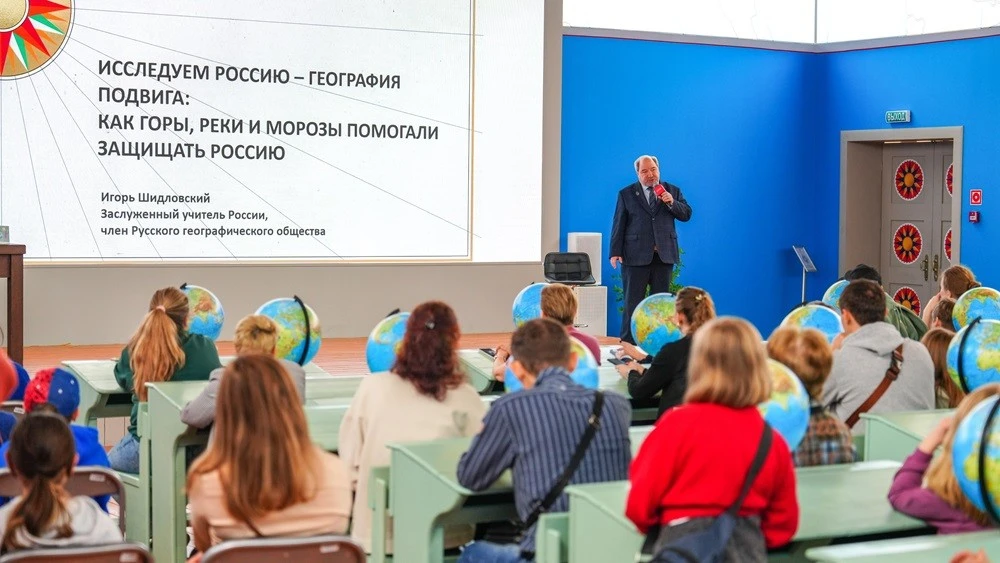
The National Centre RUSSIA hosted a meeting of the "Exploring Russia" project, "Geography of Heroic Feats: How Mountains, Rivers and Frosts Helped Defend Russia".
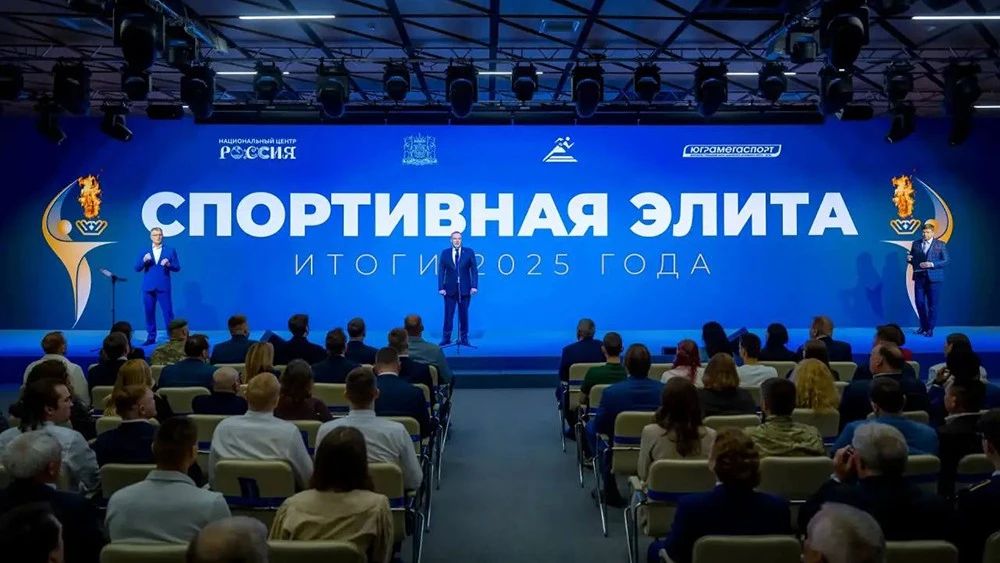
The 30th anniversary ceremony honouring the winners of the "Sports Elite of the Year" contest for 2025 was held at the National Centre RUSSIA in Yugra.


