


From the Zaraysk bison to the present day: guests of the National Centre RUSSIA explored the most ancient art on the map of our country

Every time archaeologists find something on Russian
territory that does not fit into familiar textbooks, science takes a step
forward. Sometimes it also takes a step sideways, in order to reconsider the
very ideas of what our distant ancestors were capable of. The oldest sites,
unexpected discoveries and true masterpieces created by ancient people were
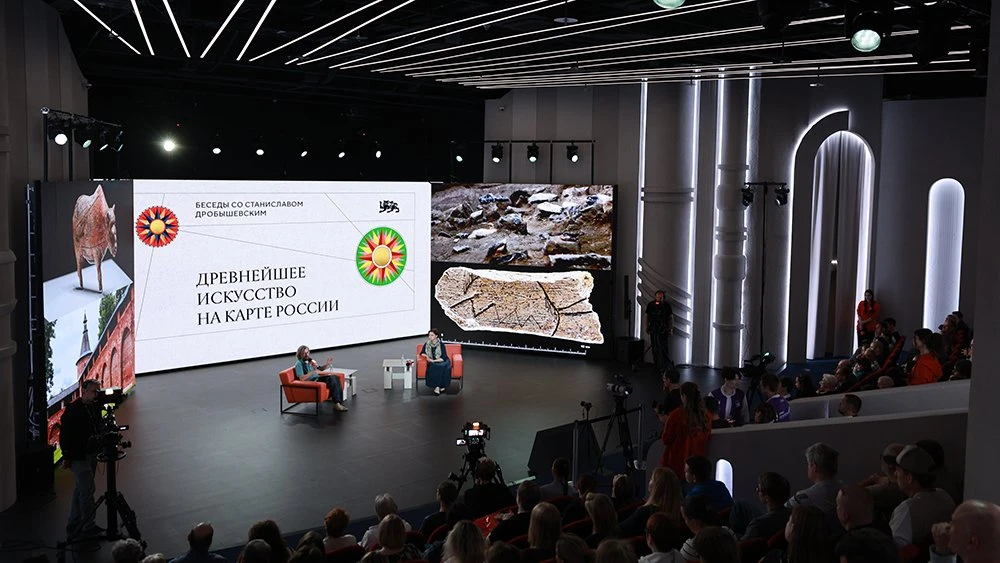
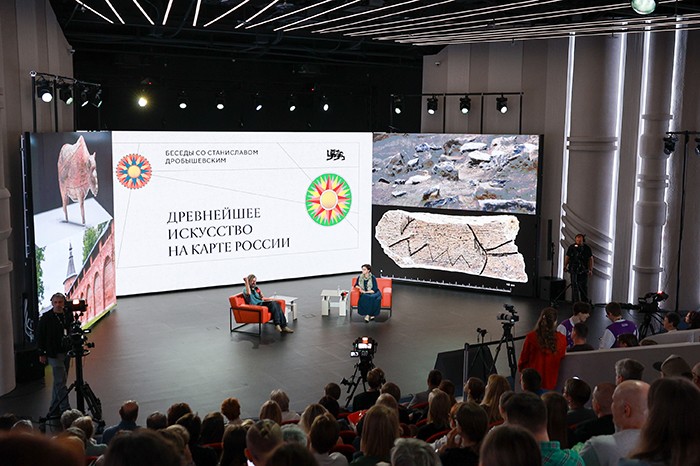
discussed at a meeting of the series "Conversations with Stanislav Drobyshevsky", which was held at the National Centre RUSSIA on 19 June.
The meaning of the event was shaped by the International
Ethnographic Triennial "Filling the Gaps: A Poem of Encounters", a
large-scale project by the National Centre RUSSIA at the intersection of
anthropology, ethnography and contemporary art. Its press launch was held just
a day before the new meeting in the series, on 18 June, in Zaraysk in the
Moscow Region. The participants in the presentation discussed, among other
things, a unique ancient find: a stone figurine of a bison created by our
talented ancestor 22 thousand years ago on the territory of modern Zaraysk.
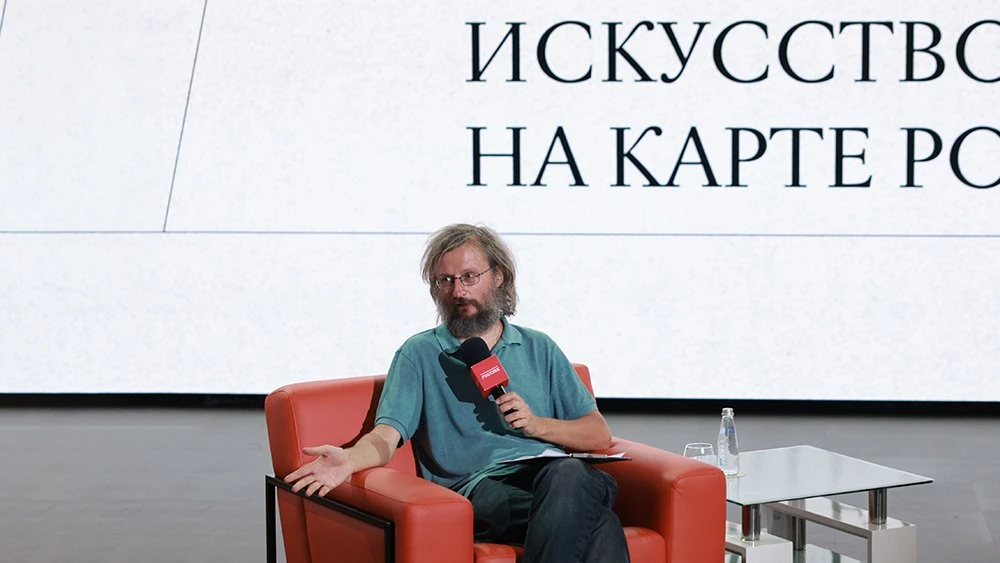
Candidate of Biological Sciences, anthropologist, Associate
Professor at Lomonosov Moscow State University, co-founder of the
Anthropogenesis.ru portal and founder of the science popularisation public
movement Drobyshevsky’s Projects Stanislav Drobyshevsky spoke about the oldest
human sites on Russian territory and the ancient art associated with them. In
addition to the famous bison, he paid special attention to another source of
pride for anthropologists: the only Neanderthal drawing in the world, found in
the village of Khotylevo. The anthropologist explained why these unique finds
can rightly be considered true masterpieces.
"These are truly world-class discoveries, because if
there used to be doubts about whether Neanderthals were capable of art at all,
now we know for certain that they were: if they did it once, then the potential
was there. Nevertheless, the Neanderthal drawing in Khotylevo is just one find
among hundreds of sites that have already been studied. This means ancient
people could do it, but did not want to. And one can then spend a long time
discussing why Homo sapiens had so much of this kind of art, while Neanderthals
had only one such object in a hundred thousand years," Stanislav
Drobyshevsky said.

He added that excavations in Khotylevo have been under way
for a long period of time, and anthropologists already know that people lived
in this area more than 90 thousand years ago. In addition, according to him,
the Micoquian culture is represented on this territory: one of the two typical
Neanderthal cultures, which extended from France and Spain to Altai.
"In particular, Neanderthals lived there, roughly from
90 to 60 thousand years ago. That is, over a period of 30 thousand years, they
came there, made flint tools, hunted mammoths and horses, and felt quite at
home. These were classic Neanderthals. True, their own bones have not yet been
found, but who else could they have been? To the right, to the left and to the
south, there were Neanderthals everywhere, and to the north there could not
have been anyone, because there was a glacier. Khotylevo features the Micoquian
culture, one of the two typical Neanderthal cultures. It extended from France
and Spain to Altai, and Khotylevo, in the Bryansk Region, lies roughly in the
middle of this area," the expert explained.
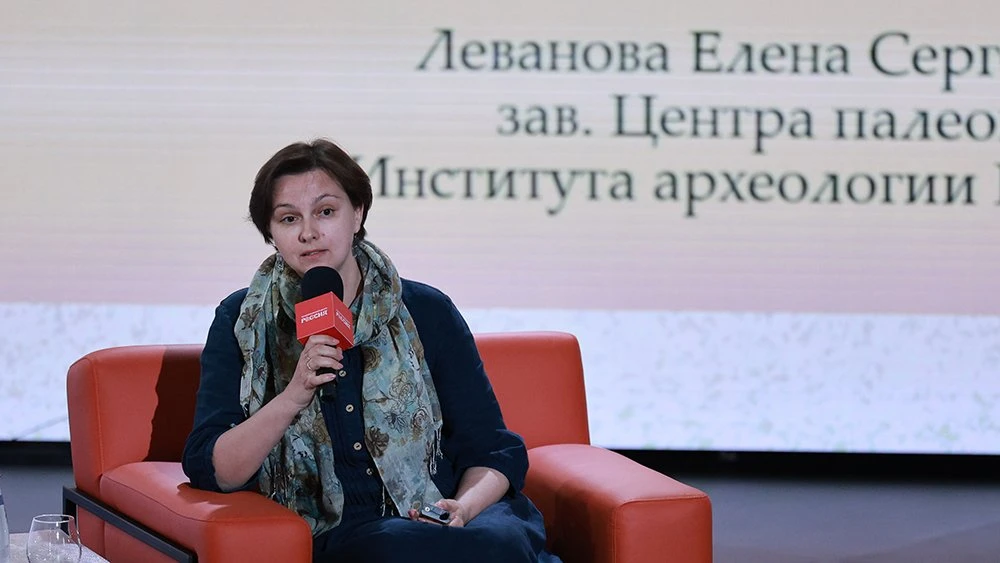
The host’s interlocutor was Candidate of Historical
Sciences, Head of the Palaeoart Centre of the Institute of Archaeology of the
Russian Academy of Sciences, Associate Professor at the Yuri Knorozov
Mesoamerican Centre of the Russian State University for the Humanities and
lecturer of the science popularisation movement Drobyshevsky’s Projects Yelena
Levanova. She said that there are many rock art sites on Russian territory,
which scholars date from the Stone Age to the present day. Many of the oldest
cave drawings, petroglyphs and rock paintings are included in the UNESCO World
Heritage List. According to Yelena Levanova, they are rarely mentioned in
textbooks, but these sites are true treasures of the country’s cultural legacy,
and many rock drawings in Russia are still waiting for their researchers.
"From the point of view of studying ancient art, all
regions of our country can be called interesting. At the same time, Yakutia,
the North-East and, in general, the entire Russian Far East are still very
poorly studied. Many discoveries are still being made in the North-West, in
Karelia and the Murmansk Region. And, of course, the Southern Urals, with its
beautiful rock paintings and cave art, is also a remarkable region,"
Yelena Levanova said.

A large part of the meeting was devoted to rock drawings. According
to Yelena Levanova, ancient people most often depicted animals that were
particularly revered in a given area.
"We see that these images, especially images of
animals, were revered. Whether people feared them or, on the contrary, admired
them, we cannot say for certain. But when we see, for example, bared jaws,
which are rare in rock art, then, of course, this is more likely to be
something frightening. Most often, however, these are simply very beautiful and
very powerful animals that were obviously symbols of might for the inhabitants
of the taiga and our large taiga spaces as a whole," Yelena Levanova
explained.
The experts discussed the origins and nature of ancient art
and paid special attention to comparing the creative abilities of Neanderthals
and Cro-Magnons. Stanislav Drobyshevsky spoke about a recent unique find: a
"scratched object" around 80 thousand years old from Khotylevo,
which, in his opinion, is an indisputable example of Neanderthal art. He
explained why these ancient people had extremely few such objects, unlike sapiens,
for whom art was widespread and linked to the development of symbolic
communication.
Yelena Levanova, in turn, spoke in detail about Upper
Palaeolithic sites on Russian territory, first of all Kapova Cave
(Shulgan-Tash) with its realistic images of mammoths, and also touched on
petroglyphs from different eras, from Lake Onega to Chukotka, noting the
similarity of images among ancient people across vast territories and the
problem of dating them.
The "Question-and-Answer" session was devoted to
key topics in archaeology and anthropology. The audience asked questions about
finds and expeditions, the specific features of ancient people’s thinking,
possible "transitional" populations and the future of human
evolution. The speakers answered based on scientific data and field
observations, often adding their personal experience of expedition work.
Stanislav Drobyshevsky and Yelena Levanova also spoke about the finds modern
anthropologists dream of making.

A recording of the event can be watched on the russia.ru
website in the "Livestreams and Videos" section and on the social
media accounts of the National Centre RUSSIA.
Conversations with Stanislav Drobyshevsky is an original
educational project of the National Centre RUSSIA, with Russian anthropologist
Stanislav Drobyshevsky as host. The main goal of the initiative is to introduce
viewers to Russia’s unique historical and anthropological legacy and the latest
discoveries in this field, as well as to expand their knowledge of the regional
features of our country. The first meeting in the series, titled "The Most
Ancient People of Siberia", was held at the National Centre RUSSIA on 14
April.
Event photobank


The National Centre RUSSIA is continuing to accept applications for the second season of the Young Journalists School.