Technical textiles as the foundation of Russia’s technological sovereignty

Which
materials will form the foundation of technological sovereignty? Can business,
science and government speak the same language? Is it possible to combine
import substitution with export potential? Who or what will create the
materials of the future? These questions were the focus of the session
"New Materials for a New Economy: Dialogue Between Business, Science and
Government" at the National Centre RUSSIA. It was a key discussion held as
part of the programme of the International Forum of Technical Textiles 2025.
"Technical
textiles will take their place in the new strategy for the development of the
light industry. We will formalise measures to increase the share of
Russian-made materials, support innovation and support exports. This is our
long-term growth plan," Anton Alikhanov said.
The
Minister of Industry noted that a number of key projects have already received
support from the ministry. These include the creation of a full-cycle
production of textile membranes, as well as the development of innovative
antimicrobial footwear for medical professionals and related sectors. He also
noted that, with the support of the Industrial Development Fund, projects aimed
at increasing productivity are being implemented. According to Anton Alikhanov,
this makes it possible not only to create new products, but also to strengthen
the sector’s production base.

"From
the perspective of the light industry’s performance, this year, despite the
challenging situation, growth of around 10% in value terms is expected year on
year. The strongest growth is being shown by the clothing manufacturing
segment, where it will exceed 24%. We expect further increases in output
volumes and believe this has become possible thanks to a balanced policy of
support for the sector. Since 2015 alone, around 97 projects have received
concessional loans from the Industrial Development Fund, totalling more than 30
billion roubles. Naturally, this is delivering results," shared the Deputy
Minister of Industry and Trade of the Russian Federation, Mikhail Yurin.
He noted that support had been provided to enterprises
focused on producing import-substituting products in the fields of industrial,
medical, construction and protective textiles. At the same time, he said,
foreign policy factors and sanctions restrictions are also affecting the
sector. To overcome these barriers, it is necessary to coordinate the efforts
of industry, the state and the scientific community. This includes the national
project for technological leadership "New Materials and Chemistry",
launched in 2025. The Deputy Minister stated that the implementation of these
projects over the next two to three years will make it possible to obtain
domestic raw materials for the production of high-quality products.

"I am
pleased with today’s opportunity to bring together in my address two industries
that are strategically important for our country: the chemical industry and the
light industry," said Artur Smirnov, Director of the Department of the
Chemical Industry of the Ministry of Industry and Trade of Russia.
He also
noted that an interdepartmental commission will take place tomorrow, during
which a number of projects in key areas of raw material supply for the light
industry will be reviewed. Among them is a project by PJSC Tatneft named after
V.D. Shashin, which includes the creation of production facilities across the
chain "paraxylene — terephthalic acid — fibre-grade polyethylene
terephthalate — fibre products". Approval is also expected for a project
by Titan Group, which will result in the production of products such as
film-grade PET, bottle-grade PET and polybutylene terephthalate. The
implementation of these projects will make it possible to fully close one of
the integrated chains from raw materials to finished products that the Department
is developing within the framework of the national project "New Materials
and Chemistry" — fibre-grade PET.

The Deputy
Head of the Secretariat of the Deputy Prime Minister of the Russian Federation
and Executive Secretary of the Commission for Scientific and Technological
Development of the Russian Federation, Antony Shvindt, highlighted the role of
artificial intelligence in the development of the domestic chemical industry.
"Artificial
intelligence today acts as a new tool for research and the creation of
materials with specified properties, accelerating scientific and technological
progress. We can see the existing groundwork and experience in this area. For
example, a neural network was developed to search for inorganic compounds. As a
result, the model identified 2.2 million new chemical compounds with various
properties. These compounds can be used in industry. There are also various
start-ups and projects being implemented by universities and research
institutes that make it possible, for instance, to automate the analysis of
scientific datasets. I would like to recall that the President separately
emphasised the role of AI in accelerating scientific research at the conference
"Journey into the World of Artificial Intelligence", and substantial
work is currently under way in this direction," he said.
Antony
Shvindt also noted that, in order to achieve the goals of the national project
"Chemistry and New Materials", an operational task force on the
application of artificial intelligence in chemistry has been established. It
brings together leading scientists and researchers from major universities and
research organisations.
Efforts are
also under way to find ways to unite the actions of the state, business and
society. This was stated by the Deputy of the State Duma and Deputy Chairman of
the State Duma Committee on Industry and Trade, Alexander Spiridonov.

"We
are talking about uniting the efforts of the state, business and society. Just
a few days ago, we held an exposition dedicated to the light industry. It
involved relevant committees, the Chairman of the State Duma, Vyacheslav
Viktorovich Volodin, and the leaders of parliamentary factions. A significant
number of problematic issues were raised. As a result, a decision was taken —
which many of you may have already heard about — to hold parliamentary hearings
at the end of January dedicated to the development of the light industry. In
this context, colleagues, in the run-up to these hearings we will be working
through all these issues and related questions, and it is very important that
you submit your materials, proposals and pain points — the problems that need
to be brought forward for discussion at the parliamentary hearings together
with the Government of the Russian Federation and the relevant ministry. We
will examine these issues in the greatest possible detail," the
parliamentarian emphasised.
The global
market for technical textiles and new materials currently stands at USD 320—350
billion and continues to grow, and by 2030 it could exceed USD 400 billion,
noted the moderator, radio and television presenter Anatoly Kuzichev. At the
same time, Russia has the potential to occupy between 2 and 5 percent of this
market, which is important not only from an economic perspective, but also in terms
of reputation and technological sovereignty. According to him, the main
challenge lies not in the technologies themselves or in lagging behind, but in
fragmentation: despite strong competencies and high demand from various
industries, segments often operate in isolation and fail to generate the
necessary synergy.
"We
all live in circumstances in which we are forced to build a new economy. The
future does not immediately take shape as a complete picture — it is formed
from elements, from pieces of a mosaic. New materials are precisely one of
those elements, without which the picture of our shared future will be
incomplete <...> There is no industry, no sector of the national economy
where new materials, and technical textiles in particular, are not in extremely
high demand. We are talking about sovereignty. We are striving to achieve
political sovereignty, but we must also achieve economic and technological
sovereignty. This is a far from trivial task," Anatoly Kuzichev added.
Event photobank


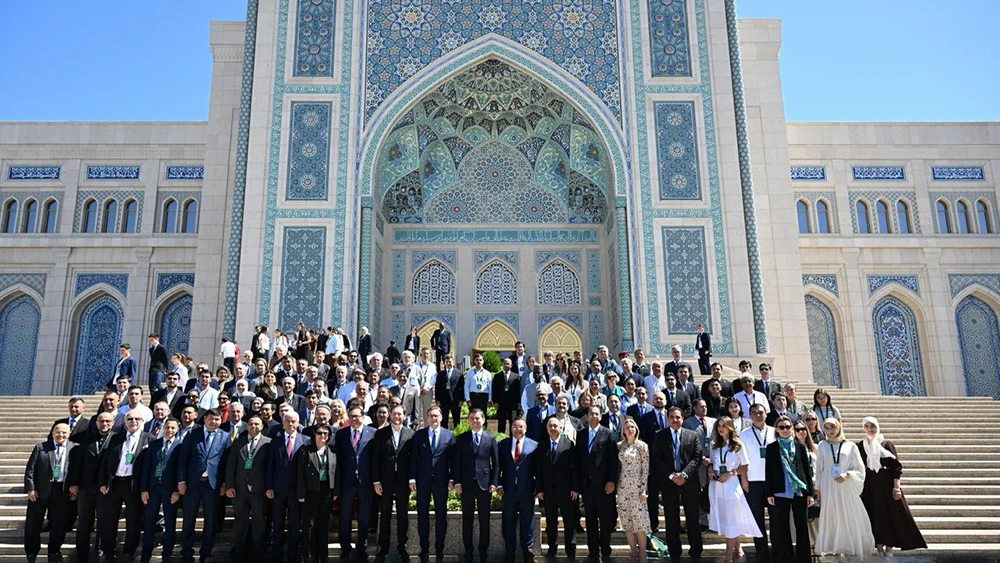
The National Centre RUSSIA and the Centre for Islamic Civilisation in Tashkent have agreed to hold the Reciprocal Days of Russia and Uzbekistan.