


The role of Voronezh universities in building the country’s technological sovereignty discussed at the National Centre RUSSIA

As part of
the Days of the Voronezh Region, the National Centre RUSSIA hosted a series of
educational panel sessions — "Universities as Drivers of the Regional
Economy" and "Geniuses of Science". Speakers and guests
discussed the role of educational institutions in the development of the
region. The sessions also featured presentations by young Voronezh scientists.
"Ensuring
technological leadership, technological independence, technological
sovereignty, import substitution," — outlined the key tasks for
universities Igor Lotkov, Head of the Secretariat of the Governor of the
Voronezh Region and moderator of the meeting.
Acting
Rector of Voronezh State University Yuri Starilov stressed in his speech that
the university has traditionally been known for its scientific schools. According
to him, new management tools provide a strong impetus for the university’s
development.
"Above
all, this is of course ‘Priority 2030’ and the advanced engineering school. Just
last week 12 student start-ups — 12 students — having gone through the
appropriate school and postgraduate programmes at Voronezh State University,
received prizes of 1 million roubles each from the Fund for Scientific
Innovation to carry out research. This proves that the university team has
created a proper material research base that makes such opportunities
possible," said Yuri Starilov.
The acting
rector underlined that the word "advance" is now key in the
industrial and scientific vocabulary.
"The
advanced engineering school, which was set up and has been operating for more
than two years at Voronezh State University, is called ‘Electronics’. Its goals
are to achieve national leadership in the development of the electronics
industry and to transfer scientific research into practical application,"
he added.

Vice-Rector
of Voronezh State Technical University Alexei Bashkirov noted that he
represents a major university with over 20,000 students and a wide range of
research fields and teams. He recalled that in 2022 President Vladimir Putin
announced a new national project, "Unmanned Aerial Systems".
"VSTU
immediately became involved in this work. A commission from the Ministry of
Science and Higher Education came to us. We presented our competencies and were
supported. Every six months we undergo an evaluation of our actions, reporting
on real products and technologies. As a result, during this time we have
received 400 million roubles in support for development. Within this project, a
design centre ‘Power Electronics’ has been created, including for the component
base in the field of unmanned aerial systems," said Alexei Bashkirov.
He
emphasised that the aim of the university’s work in this area is to replace
imported components used in drones — electric motors, propeller groups, flight
controllers, communication systems and other parts.
"Three
structures have been created at the university: a training and production complex
for unmanned aerial systems, through which more than 200 students pass each
year with paid employment. They are involved in developing high-tech solutions
and prototypes, which we can independently manufacture and supply to our
partners," Alexei Bashkirov continued. "Without doubt, a large number
of specialists and high-tech solutions are needed to develop this industry. For
the region this means forestry, the Ministry of Emergency Situations,
agriculture above all, and cargo delivery. These are the goals set by the
President for Russia. We are trying to contribute to achieving them."

Rector of
Voronezh State University of Engineering Technologies Nikolai Repnikov noted
that his university is engaged in areas related to processing, primarily for
the food and chemical industries.
"On
some tracks we are the only university that has preserved competencies,
including research, across all types of food production. Today, for example, we
are the only ones in the country training technologists for sugar factories.
You know that sugar is a strategic product," he said. "We have
carried out an important project to develop protein ingredients of various
kinds. There was no such type of production in our country at all. And such
strategically important products as baby food, diet food, sports nutrition —
all improving people’s health — used to be produced only from imported raw
materials. Now our country has its own."
According to the rector, the university conducts vital research aimed both at the agro-industrial sector and the development of food production: "I would not be wrong to say that today the best laboratory for microbiological research in Voronezh has been created on our base. Within this activity we have 24 young researchers under the age of 39. Almost all have received academic degrees, and some are already preparing doctoral theses."
Dmitry
Zhukalin, Head of the Department for Strategic Development and Project
Activities at Voronezh State University of Forestry and Technologies named
after G. F. Morozov, noted that five key universities for the region are taking
part in the panel discussion. Each of them has its own project, supported by
the Russian government and aimed at engaging industrial partners, in whose
interests real applied tasks would be solved.
"For
example, modern forest fire centres in Russia and worldwide are interested in
modelling different situations that may occur in forests, in monitoring with
the help of unmanned aerial vehicles. Here a consortium with Voronezh
universities can also be very useful. There are companies that come for special
developments, for which the Forestry University produces specific prototypes
that then go into production," said Dmitry Zhukalin.
He also addressed the students, experts and employers present in the hall: "Without those who are here today, none of this will work. It is you — the people who must actively join this process, become researchers in the engineering centre and help universities, as drivers of the economy, to develop not only the region but all of Russia."

Advanced
engineering schools are becoming a real tool not only in training specialists
but also in achieving technological sovereignty, said Natalia Derkanosova,
Vice-Rector for Academic Affairs of Voronezh State Agrarian University named after
Emperor Peter the Great.
"For
us, this field is not just an educational task but a comprehensive mission that
brings together science, production and agribusiness," she stressed.
According
to her, the university is actively working on creating a system where students,
already at the stage of study, become participants in real scientific and
production projects. This allows them not only to acquire knowledge but also to
apply it in practice straight away, seeing the final result of their work.
"Another
important aspect is the development of international cooperation. Despite the
current difficult circumstances, we strive to build partnerships with
colleagues from other countries to share experience, take part in joint
research and introduce best practices in agricultural genetics and
breeding," Natalia Mitrofanovna emphasised.
However, the university’s main task is to contribute to the country’s food security, said Natalia Derkanosova: "We must ensure the market is supplied with domestic varieties and hybrids resistant to today’s challenges — whether climate change, plant diseases or new production requirements."
The panel
session "Geniuses of Science" became a continuation of the first
discussion. Young researchers presented their projects that had received
support from the regional government.
The session
also addressed key areas of support and development of science in the region,
including the analysis of regional measures to support young scientists and the
operation of an IT platform to inform about them, the Congress of Young
Scientists and satellite events to solve scientific and technological
challenges. The discussion covered the development of domestic
microelectronics, the creation of unmanned aviation systems, the advancement of
protein ingredients and biologically active peptides for the food industry and
specialised nutrition, as well as the cooperation of educational institutions,
research laboratories and industrial enterprises to integrate science into
practical activities and to train highly qualified personnel.
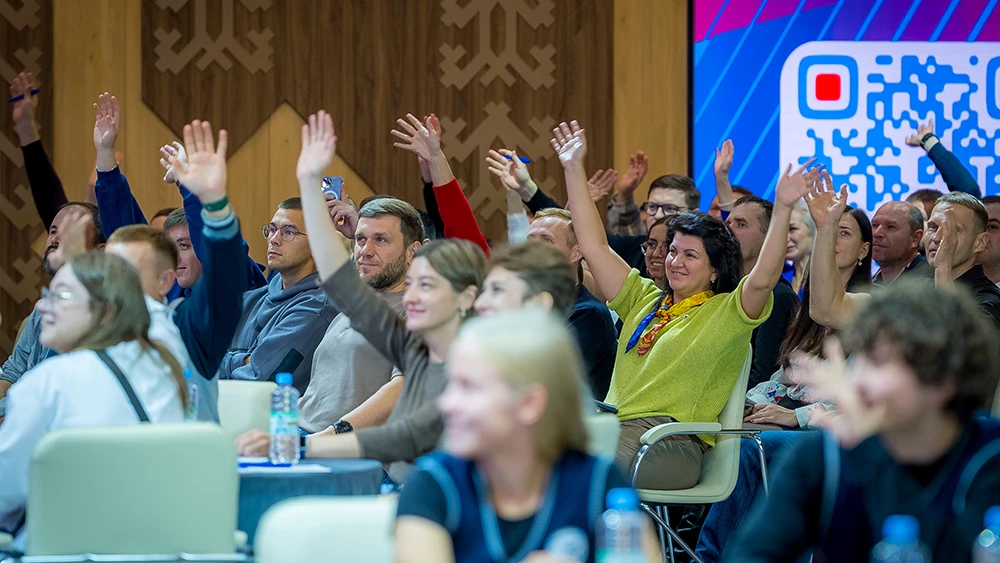
At the
conclusion of the session, participants were able to ask the speakers questions
about the work of universities, future directions of development, and
opportunities for admission to one of the universities represented.
Event photobank



On 4 October, the All-Russian Sports Dictation, a nationwide educational initiative of the Russian Olympic Committee, was held at the National Centre RUSSIA in Yugra.


