Military historians spoke at the National Centre RUSSIA about Hitler’s final days
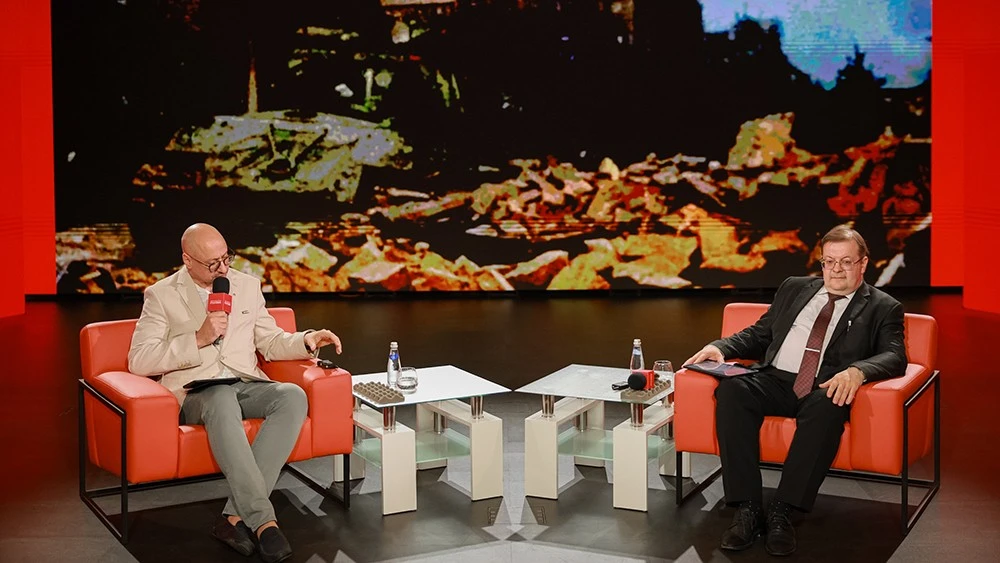
During the
storming of Berlin by Soviet troops, Hitler did indeed commit suicide, but it
was not planned in advance and was rather the result of the implementation of
the Soviet command’s universal plan. This was discussed by experts at the first
lecture in a new cycle of historical meetings at the National Centre RUSSIA.
They examined the main myths connected with the historic battle of May 1945 and
paid special attention to one of the most popular misconceptions: that the
German dictator did not take his own life, but fled Berlin for Argentina.
As military
historian and member of the Academic Council of the Russian Military Historical
Society Alexei Isayev explained, the Führer’s suicide was not the result of a
hunt for him, but the consequence of the Soviet command’s competent strategy,
although it had set itself entirely different tasks.
"From
the very beginning, no one set the task in military plans of reaching Hitler
and forcing him to kill himself. From a military point of view, that was a
pointless task. Hitler could have been anywhere: in a bunker, in the metro and
so on. The meaningful task was to split the garrison and defeat it piece by
piece. And the fact that, by reaching the city centre, we forced Hitler to
commit suicide could not have been included in the plan. It was the result of a
universal concept that would have produced results in any case," Alexei
Isayev explained.

Director of
the "I Remember" Foundation and member of the Academic Council of the
Russian Military Historical Society Artyom Drabkin added that Hitler’s decision
to take his own life developed gradually, starting on 22 April 1945, when he
had a hysterical outburst and declared that he would die in Berlin.
"Hitler
stated that he would die here, with the fall of Berlin, and would not go
anywhere. He even said that he was ready to hand over his power to someone
else. His entourage suggested that he leave for his residence at Obersalzberg
and even tried to take him out by force, but nothing came of it. By the end of
April, he was already saying clearly how he would kill himself. Ampoules of
poison were delivered to him, and he had two pistols," Artyom Drabkin
said.
According
to the expert, Soviet secrecy, oddly enough, played a considerable role in the
emergence and spread of the myth about the dictator’s escape. The remains of
Hitler and Eva Braun were reburied several times, and in 1970, on the
instructions of Yuri Andropov, Operation Archive was carried out: the remains
were exhumed, finally burned and scattered.

"I
spoke with KGB officers who wrote the documents on this burning. And they said
that even the documents indicated a different place. So today no one knows
exactly where the ashes were scattered. But we can say for certain that Hitler
was dead on 30 April," Artyom Drabkin assured.
A new cycle
of historical meetings and lectures dedicated to great events of our past began
on 22 May at the National Centre RUSSIA with the support of the Russian
Military Historical Society, the "I Remember" Foundation and the
Presidential Foundation for Cultural Initiatives. Its main goal is to speak
about the country’s history in an accurate and engaging way, awakening in listeners
a sense of pride and belonging. Events in the cycle, featuring leading
historians and invited experts, will be held monthly.
The next
meeting in the cycle will take place on 23 June. The Open Lecture Hall
"Myths and Truths of 22 June 1941" will debunk the main myths about
the first day of the Great Patriotic War using figures and facts. The event can
be visited free of charge with advance registration on the russia.ru website in
the "Events" section.