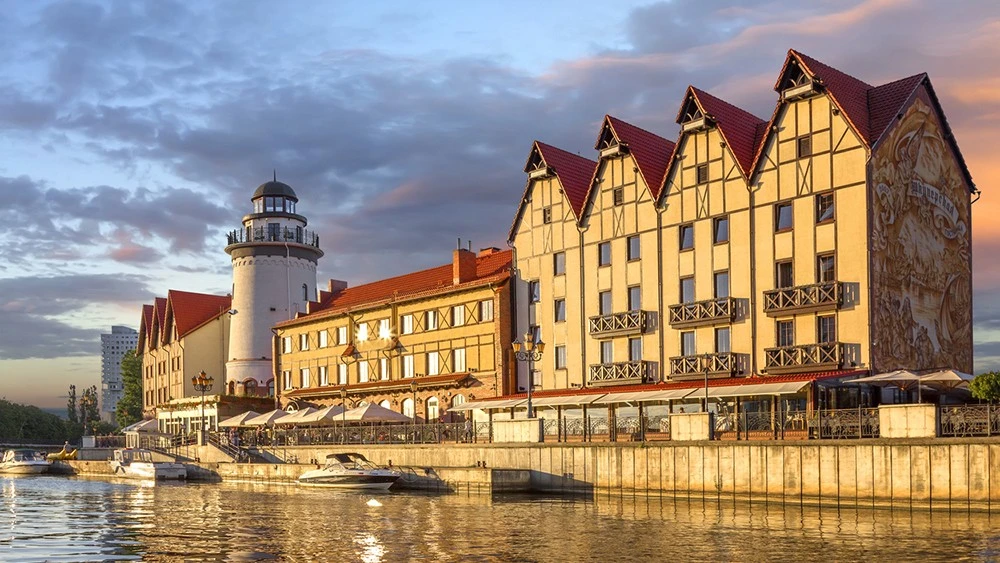
"Battle of Talents: Dostoevsky vs Bulgakov" at the National Centre RUSSIA
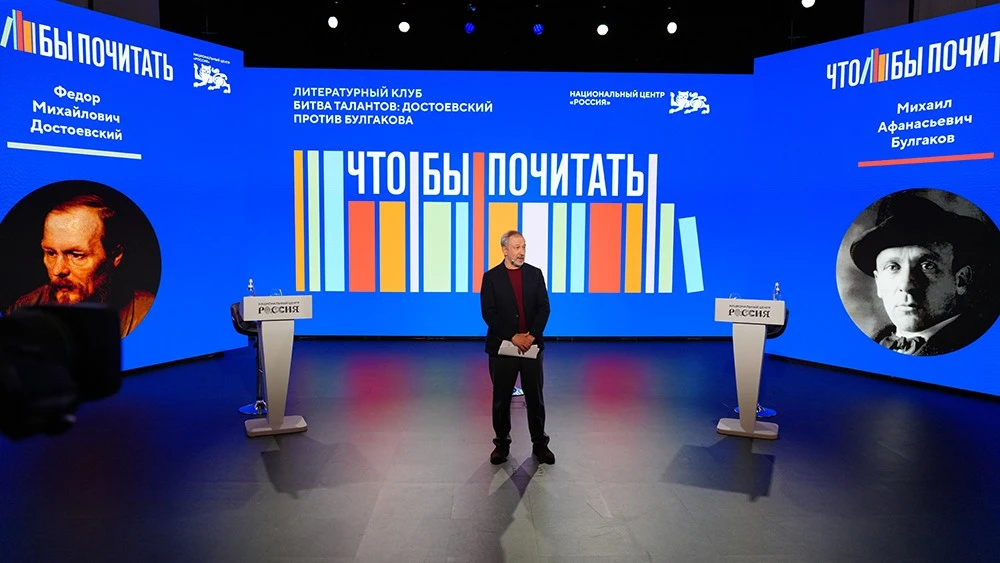
A meeting of the Literary Club "What to Read?!" was held at the National Centre RUSSIA in the format of an intellectual duel. The topic of the debate was "Battle of Talents: Dostoevsky vs Bulgakov". Together with experts, guests reflected on whose legacy has a stronger influence on our understanding of the human being, Russia’s destiny and modern culture. The meeting gained particular intrigue because father and son found themselves on opposite sides of the "literary barricades": Doctor of Philology, Professor at Moscow Pedagogical State University, writer, literary scholar and publicist Yevgeny Zharinov spoke in favour of Fyodor Dostoevsky, while philologist, culturologist and writer Nikolai Zharinov argued in favour of Mikhail Bulgakov.
The intellectual duel was moderated by Alexei Chesnakov, Head of the Scientific Council of the Centre for Current Politics and Professor at HSE University.
"The topic of our meeting today is 'Battle of Talents: Dostoevsky vs Bulgakov'. And it is a battle of talents in two senses: the most published and most popular writers in Russia are Fyodor Mikhailovich Dostoevsky and Mikhail Afanasyevich Bulgakov. It is also a battle between two of our contemporaries: literary scholar Yevgeny Zharinov and culturologist and writer Nikolai Zharinov. A little secret: they are father and son, representatives of a creative dynasty," Alexei Chesnakov noted.

The structure of the debate was built around three thematic blocks. The first focused on the writers’ lives, temptations, passions and muses. The second explored their relationships with power, from Nicholas I to the Soviet era. The third considered how Dostoevsky and Bulgakov should be read today: which texts to start with, which works are worth rereading in adulthood and which themes resonate particularly sharply with the modern reader. The format, with clear timing and rounds of cross-questions, gave the discussion momentum and made it possible to identify not only the differences but also the points of convergence in the legacy of the two authors.
At the beginning of the discussion, the experts recalled that the two classics are united not only by their status as key figures in Russian literature, but also by their biographies. Dostoevsky and Bulgakov came to literature from other professions, experienced poverty and illness, and constantly reinterpreted freedom, faith, temptation and responsibility in their texts.

Speaking about the early Dostoevsky, Yevgeny Zharinov focused on the novella "Poor Folk" as the point at which the main theme of his work was already beginning to emerge.
"In 'Poor Folk', Dostoevsky takes the aristocratic epistolary genre and places it in the hands of two poor, almost destitute people. They live in such poverty that, as he put it, it had 'eaten into their very being'. But it is from this poverty that a feeling is born which rises to the Gospel formula, 'Blessed are the poor in spirit'. For Dostoevsky, suffering is not a backdrop, but a path to truth, and that is why his characters still affect us so deeply," said Doctor of Philology and Professor at Moscow Pedagogical State University, Yevgeny Zharinov.
A separate part of the conversation was devoted to how cities and personal experience shaped Bulgakov’s view of the world. Nikolai Zharinov emphasised that two spaces were particularly important for the writer: pre-war Kiev and Moscow in the 1920s.

"For Bulgakov, childhood is first and foremost Kiev, with its opera theatre, music and home productions of 'Faust'. He comes to 'Faust' through Gounod’s opera, meaning that he enters literature through theatre. Then comes the sharp contrast of Moscow in the early 1920s. To understand what kind of time it was, one fact is enough: Lenin’s limousine was stolen in the city centre after he himself, Krupskaya and the chauffeur were simply thrown out of the car. Against this background, the writer, who only recently had lived in a house on Andreyevsky Descent, sits behind a curtain in six square metres on Sadovaya Street and writes 'The White Guard' as a novel-memoir about home. This experience of two cities — a happy childhood and harsh Moscow reality — explains a great deal about his attitude to people, power and art," noted philologist, culturologist and writer Nikolai Zharinov.
The experts also discussed the mystical dimension in the work of both authors. Yevgeny Zharinov emphasised that the figure of the devil in Dostoevsky and Bulgakov plays not an episodic but a worldview-shaping role: "Both Mikhail Afanasyevich and Fyodor Mikhailovich were mystics. In 'The Brothers Karamazov', Ivan’s dialogue with the devil is of enormous importance; this character is incredibly charming in Dostoevsky. In Bulgakov, 'The Master and Margarita' rests on the figure of Woland: remove the devilish line, and the novel falls apart. In both cases, the devil returns to the text as a test, an interlocutor, a temptation and part of the conversation about freedom and faith."

Nikolai Zharinov, in turn, showed that Dostoevsky and Bulgakov are connected by more than separates them. He recalled the story of how a personal comparison with Dostoevsky became a painful point for Bulgakov, but at the same time an inner standard below which he did not want to fall. The expert separately focused on how Bulgakov inherits from Dostoevsky in "Heart of a Dog": "Bulgakov conveys the suffering and consciousness of the dog with astonishing precision — this is an absolutely Dostoevskian intonation. Suffering here purifies, almost elevates to the human level. At the same time, he is unable to enter the mind of the proletarian with the same depth: only reactions and instincts remain there. This contrast says a great deal about his view of the human being and why this novella could never have been published in Soviet times."
Moreover, the expert noted that the authors are connected by much more. According to him, the most traumatic memory for Bulgakov was the moment he transferred into the novel "The Master and Margarita". Nikolai Zharinov recalled the story in which the cat is asked, "Where are your papers?", and replies that Dostoevsky had papers because he was a writer. And the girl with a clear gaze says to him, "You are not Dostoevsky." Nikolai Zharinov explained that this phrase was said to Bulgakov by his second wife, Lyubov Belozerskaya. The writer was desperately trying to work, while Lyubov Belozerskaya often spent a long time speaking to her friends on the telephone, which stood directly above his desk. When Bulgakov could no longer bear it and said, "Lyuba, even Dostoevsky did not work in such hard-labour conditions," she turned to him and replied, "You are not Dostoevsky." For Bulgakov, it was like a slap in the face.

At the end of the meeting, an audience vote was held. The majority of participants, 55%, preferred Dostoevsky for his uncompromising conversation about the depths of the human soul and the tragedy of freedom, while the remaining 45% chose Bulgakov for his irony, philosophical multilayeredness and ability to bring reality and mysticism together in a single artistic world.
The debate concluded with a series of questions from the audience. All guests of the event who asked the experts questions were given books: Bulgakov’s novel "The Master and Margarita" and Dostoevsky’s "The Brothers Karamazov".
You can watch the recording of the livestream at russia.ru website.
The Literary Club "What to Read?!" is an original project by the National Centre RUSSIA. The club’s meetings help participants look at familiar texts in a new way, discover a living conversation about the present day in the classics, and feel that literature remains a space of personal choice and meaning. Anyone can take part in the club’s events and other educational programmes of the National Centre RUSSIA free of charge by registering in advance on the russia.ru website in the "Events" section.
Event photobank


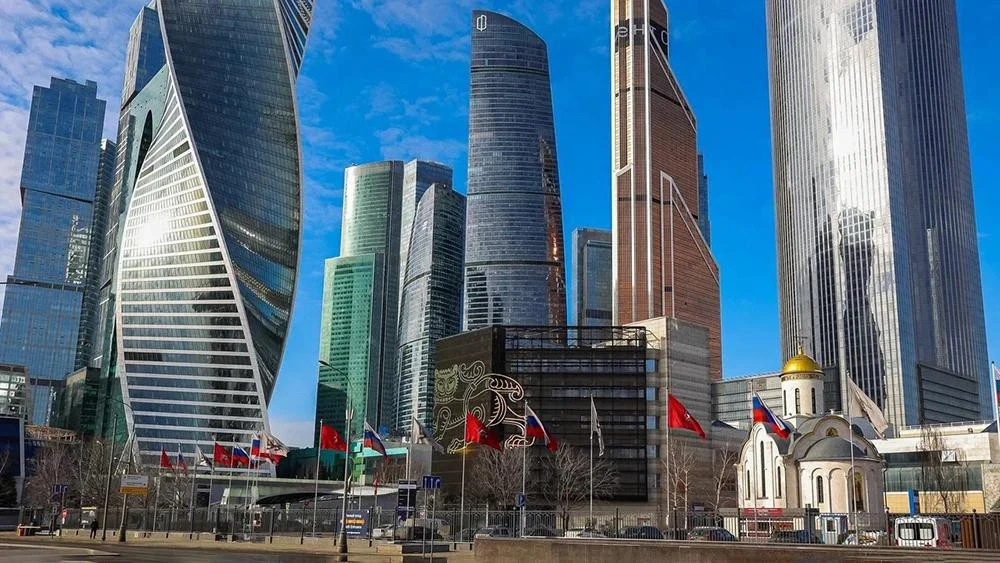
The National Centre RUSSIA has ranked among the top four Russian venues by the number of international events held between 2019 and 2025.
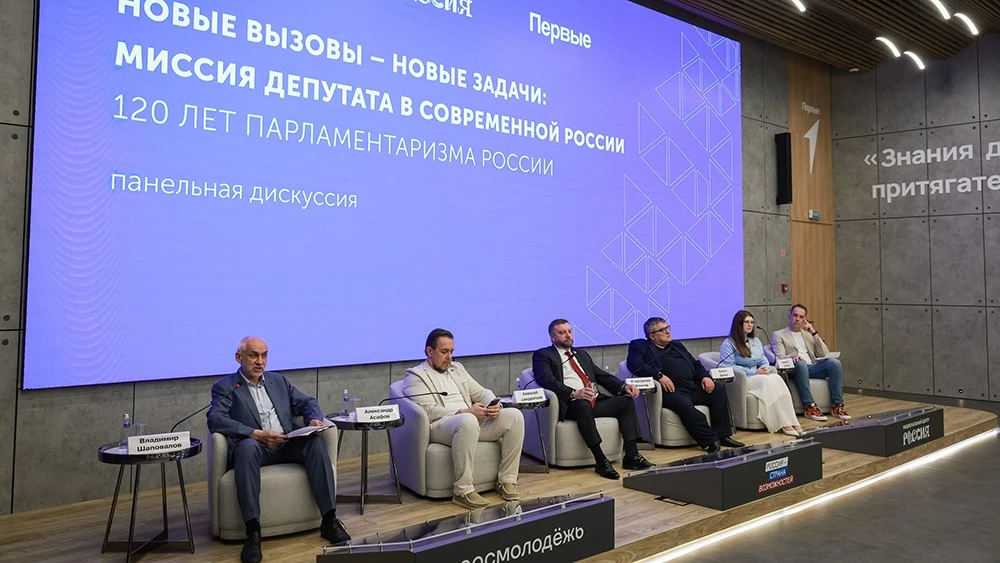
The panel discussion "New Challenges — New Tasks: The Mission of a Deputy in Modern Russia. 120 Years of Parliamentarism in Russia" was held at the National Centre RUSSIA on 3 July.