

Maxim Oreshkin and Tigran Khudaverdyan on digital platforms, AI and the economy of the future
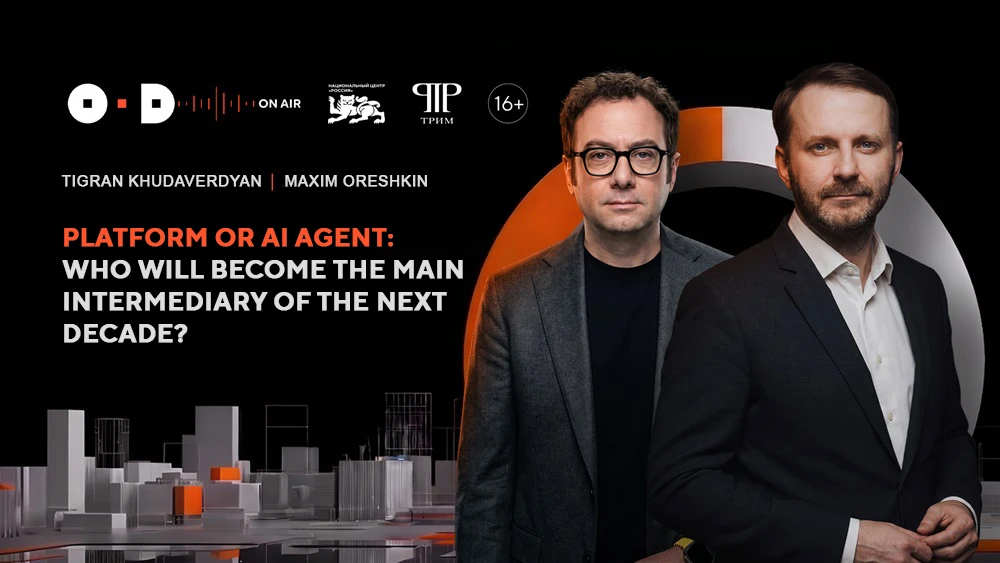
A new episode of the Summer Expert Meetings of the Open Dialogue featuring the Deputy Chief of Staff of the Presidential Executive Office of Russia, Maxim Oreshkin, and Board Member of Yandex Rus JSC Tigran Khudaverdyan has been released on the official website and social media accounts of the National Centre RUSSIA. The main topic of the meeting was the future of the digital economy and the interaction between digital platforms and artificial intelligence. The episode is available via the link.
According to Maxim Oreshkin, platforms will retain their key role in the digital economy, while AI agents will become a tool helping users interact with them more effectively: "Platforms will remain a tool for finding counterparties, concluding deals and carrying out transactions, while AI agents will reduce information asymmetry. No one yet understands exactly where the boundary between their roles will lie."
Today, the platform model is expanding into an increasing number of sectors, from transport and retail to education and healthcare. At the same time, algorithms capable of efficiently balancing supply and demand in real time are becoming the key factor in competition.
"In reality, all the competition taking place in the world today between companies operating in the same markets comes down to one company arriving with algorithms and a formula for balancing supply and demand that is better than another company's. In the long term, this is precisely what determines the efficiency of the system," noted Tigran Khudaverdyan.
According to him, software development has become the first industry where artificial intelligence is already delivering a significant economic effect. The use of AI accelerates software development and improves the efficiency of engineering teams.
"Over the past year, there has been a change: the first industry where there is already an economic effect, and a very significant one, is software development. Today, the gains achieved through the use of artificial intelligence in software development pay for themselves many times over," he emphasised.
At the end of July, Yandex unveiled its "75/75/75" programme, which provides for the large-scale integration of AI into the development process. By the end of 2026, the company expects the majority of developers to use artificial intelligence regularly, while most changes to software code will be created with its involvement. According to the company, this will accelerate the development of new products and improve development efficiency.
Maxim Oreshkin noted that the introduction of artificial intelligence should be assessed primarily in terms of its practical benefits for the economy and society.
"The most important thing is the extent to which we introduce new technologies, the extent to which they create new added value from an economic perspective and deliver high-quality outcomes for people from a social perspective. At the same time, all of this can be undermined if security is not ensured," Maxim Oreshkin emphasised.
According to Tigran Khudaverdyan, the next stage of development will be the emergence of personal AI agents capable of carrying out tasks for users and businesses while interacting with digital platforms.
"It will be possible to send one assistant to deal with home renovations and another to enroll a child in school or kindergarten," he said.
According to him, the task of companies such as Yandex is to create a technological platform on which AI can interact safely with digital services, perform actions and carry out transactions on behalf of the user.
Maxim Oreshkin emphasised that the development of AI agents will not eliminate the role of digital platforms, but will complement their capabilities, making digital services more accessible and efficient for users. The full version of the discussion is available on the YouTube channel of the National Centre RUSSIA.
The Open Dialogue is an international project dedicated to discussing the future of the global economy and identifying new models for global development.
The project, organised jointly with the Centre for Cross-Industry Expertise "Third Rome", brings together representatives of business, science, government institutions and the expert community from different countries. Since its launch, the initiative has brought together more than 3,000 authors and experts from over 120 countries, becoming one of the largest international discussion platforms focused on developing practical solutions amid the transformation of the global economy.
The II Open Dialogue was held on 27–29 April 2026 at the National Centre RUSSIA, bringing together representatives of governments, international organisations, business, science and the expert community to discuss key challenges and prospects for global economic development.
The new episode of the National Centre RUSSIA Open Dialogue podcast explores key questions of the digital age: who owns AI and data.

The new episode of the National Centre RUSSIA Open Dialogue podcast begins with the idea that artificial intelligence is no longer merely a digital tool.