"Education Through Stories": the premiere of the Open Lecture Hall about the future was held at the National Centre RUSSIA

The
premiere of the Open Lecture Hall "Inventing the Future: Plots and Stories" was held on 7 February at the National Centre RUSSIA. It is a
series of meetings with scientists, futurists and experts from different
countries devoted to the art of storytelling in advertising, cinema and video
games. The ability to present material in an engaging way is increasingly
becoming a tool of education, marketing and entertainment, helping to build
emotional connections and deeper immersion in stories about the past, present
and future.
The Open
Lecture Hall opened with the theme "Education Through Stories". It
was launched by the Director General of the National Centre RUSSIA, Natalia
Virtuozova.

"The
National Centre RUSSIA was created by order of the President of the Russian
Federation, Vladimir Putin. Here we conduct an open dialogue about the future
and strive to ensure that everyone becomes its co-author. Talking about what it
will be like is our key task, because the future is shaped by what we create
and tell. Today marks the premiere of the Open Lecture Hall 'Plots and
Stories', which emerged as part of a symposium held this autumn. During
discussions with participants from different countries, we realised that this
format is in demand. The symposium became part of a broader Open Dialogue,
which we invite everyone to join — an honest, vivid, bold and engaging
conversation about our future. We clearly understand that in order to move
forward, it is not always necessary to invent something new — it is important
to rethink experience we already have," said Natalia Virtuozova.

She noted
that historical heritage is a "launch pad" for moving into the
future. Natalia Virtuozova stressed that many storylines around the world are
similar, and that the time has come to retell them through one’s own traditions
and meanings. As an example, she referred to the exposition "Book of Fairy
Tales" at the National Centre RUSSIA. It is not simply an exposition, but
a "journey" in which visitors live through a fairy-tale path — with a
choice between good and evil — and emerge transformed, becoming co-authors of
what unfolds.
"Visual
elements are playing an increasingly important role in storytelling today.
Visualisation is emotion, imagery, a picture that helps people feel and
understand. This is precisely where difficulties still arise. From early
childhood we are taught to write, but in modern storytelling it is especially
important to learn to think in images and convey meaning through visuals. To
truly tell a story, you need to be able to see it and show it. At the same
time, what remains unchanged, in my view, is what is set out in the Bible —
biblical truths. Everything else is new retellings and reinterpretations,"
Natalia Virtuozova added.

In today’s
world, storytelling plays an enormous role. Because of the complexity of
ongoing events, many people find it difficult to make sense of what is
happening, which is why the need for those who can explain complex things
simply and clearly continues to grow. This view was shared by the US producer,
screenwriter and director, Mehret Mandefro.
"Storytelling
has always been about understanding the world and our own lives. We need to pay
attention to who is telling us about the world and from what perspective. Only
then do we create our own 'frame' — the way through which we see the world.
Everyone needs to learn how to manage their own frame. In the past, we could trust
experts, but today facts are no longer always convincing, while fiction can
sometimes feel more persuasive. The internet is filled with viral videos, and
this confuses people. I call this the 'holy trinity' of storytelling. At the
top is the story and your voice. In the middle is perception, which is always
subjective. At the bottom is behaviour — action or inaction. The most critical
point is bringing the external world closer to the inner voice. Each of us must
become a storyteller, able to speak clearly and simply about ourselves and our
lives. If we do not learn this, we will be ignored — we will become
invisible," she said.

The author
of the YouTube channel "History by Cherny", Alik Cherny, suggested
that in the future storytelling may move away from reading and retelling texts
towards a technology of "genetic immersion". Using nano-doubles and
the reading of genetic memory, people could synchronise with the experiences of
their ancestors.
"In
the near future, an 'avatar' will appear that is fully infused with our
feelings and emotions. It will be a hologram that cannot be harmed and cannot
influence anything. It can be sent into a specific historical time or event —
Ancient Greece, Ancient Rome, Ancient Rus’. And when the hologram is there, we
will be able to feel the breeze, touch the Nile, sense everything in our hands.
We will be able to walk through a market and smell freshly baked bread,"
Alik Cherny explained.

He added
that future technologies and neural mechanisms could transform the very understanding
of history — allowing people not just to memorise dates and rulers’
biographies, but to immerse themselves more deeply in the past, understand the
languages and contexts of ancient cultures, and even live through the
experiences of ordinary people rather than only famous figures. According to
him, it will be essential to interpret and convey such experiences through
storytelling, clearly understanding what the story is about, who it is for and
what its purpose is.
Throughout
the day, Russian and international experts discussed how stories and
storytelling are transforming education, advertising, cinema and games. The
speakers’ visions of the future were visualised in AI-generated videos
accompanied by the storyteller character Alice from the future. She was created
by the team of KROLIKI at the First Neurocontent Cup and became the symbol of
the project "Inventing the Future".

As part of
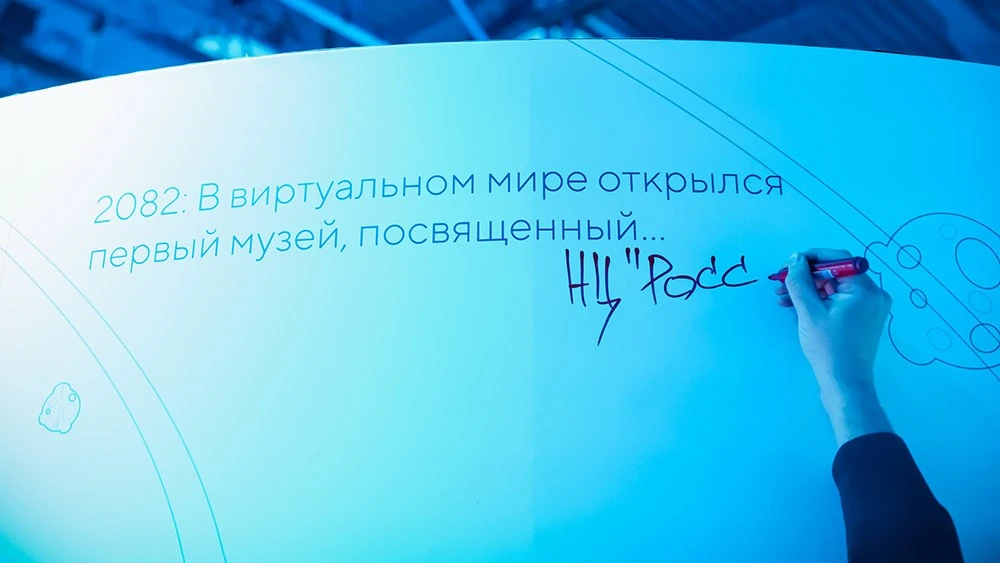
the Open Lecture Hall, the National Centre RUSSIA also presented the exposition
"Once upon a time I…", dedicated to the practice of storytelling and
collective narrative. Guests can continue the phrase "Once upon a time
I…" in the form of text or drawing, sharing personal stories, ideas and
visions of the future in order to create a shared picture of tomorrow together.
The Open
Lecture Hall "Inventing the Future: Plots and Stories" is an original
project of the National Centre RUSSIA that emerged within the framework of the
II International Symposium "Inventing the Future". Owing to strong
audience interest, the lecture series was decided to be developed as a
standalone format.

The
National Centre RUSSIA invites everyone to become co-authors of our future at
the III International Symposium "Inventing the Future", which will
take place in November 2026 and will focus on the unity of peoples in science,
culture and art.
The Open
Lecture Hall can be watched on the website russia.ru in the "Livestreams
and Videos" section, as well as on social media and video platforms of the
National Centre RUSSIA.
Event photobank

 31
31