
Uncovering the mysteries of the past: the National Centre RUSSIA congratulates archaeologists on their professional holiday
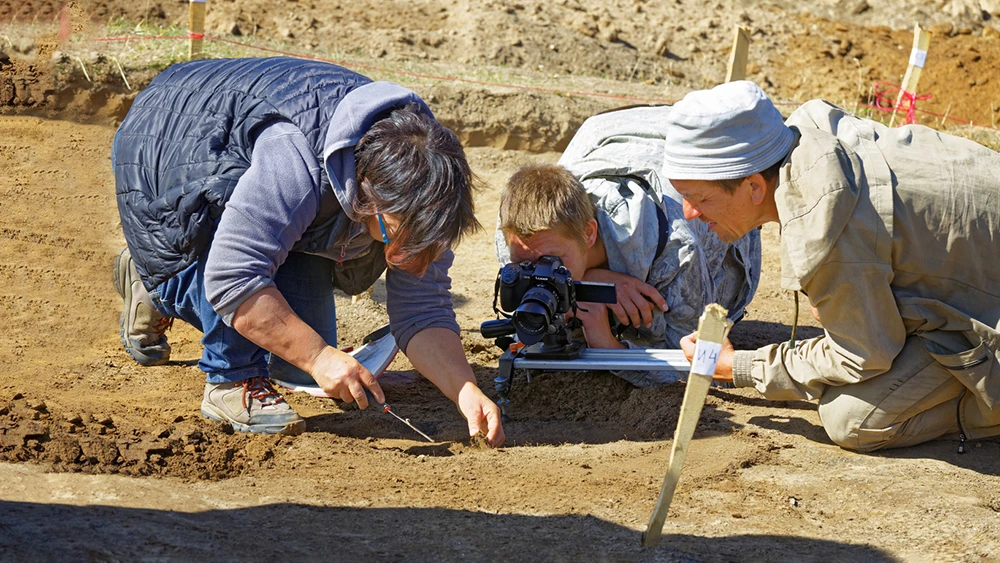
Archaeologist
Day is celebrated in Russia on 15 August — a professional holiday for
specialists who reconstruct the history of humankind from material evidence.
The date has no official status, but the tradition of marking it emerged in
Russia as far back as the 1930s and has since become firmly established within
the professional community.
Archaeology is a science that allows us to look into the past through objects
that have survived to the present day. Ancient tools, pottery, weapons,
jewellery, the remains of buildings, burial sites and sanctuaries become a kind
of "witness" to bygone eras for researchers. Individual finds allow
specialists to reconstruct how people lived, as well as aspects of their everyday
life, culture and beliefs.
Several stories are associated with the origins of the holiday. According to
one version, the tradition arose during excavations at Staraya Ladoga led by
Professor Vladislav Ravdonikas. In the 1930s, members of the expedition decided
to mark 15 August as Archaeologist Day, and congratulatory telegrams were soon
sent to other expeditions as well. Today, these documents are kept in the
archives of the Russian Academy of Sciences. Another version attributes the
origins of the tradition to Artemy Artsikhovsky's Novgorod expedition.
Archaeology students proposed celebrating the birthday of Bucephalus, the
legendary horse of Alexander the Great, on 15 August. Over time, the original
reason was forgotten, but the date remained. Yet another version links
Archaeologist Day with the prominent Soviet scholar Tatyana Passek. At first,
15 August was celebrated by members of her expedition, before the tradition
spread to other archaeological teams. Whatever its origins, the holiday has
long since become part of archaeologists' professional culture.
For many specialists, 15 August is spent at archaeological expeditions, as
mid-August falls at the height of the fieldwork season. The holiday also has
its own traditions: initiation ceremonies for newcomers to archaeology, various
challenges, shared dinners around a campfire and songs accompanied by guitar.
Museums and research institutions mark the date with themed expositions,
lectures, book presentations, conferences and tours of excavation sites.
An archaeologist's work, however, does not end with the discovery of an ancient
object. Artefacts that have been found must be studied, preserved and presented
to a wider audience. This is where archaeology becomes part of educational
work: scientific discoveries help people better understand the history of their
country, see the connection between past and present and recognise the value of
cultural legacy.
The National Centre RUSSIA places great emphasis on preserving historical
memory and engaging a broad audience through educational initiatives. Here, the
country's history and culture become the focus of expositions, educational
programmes, lectures and other cultural and educational projects. This format
makes it possible not simply to tell people about the past, but to make
historical knowledge accessible and relevant to modern audiences.
In this respect, archaeology provides a particularly vivid example of how
historical memory is formed. A small object uncovered during an excavation can
tell the story of an entire generation. The task of an educator is to help
people see the human story behind that object and understand its significance.
Archaeologist Day is a reminder that history is preserved not only in
chronicles and documents. It remains in objects, buildings, cultural layers and
other material evidence of the past. Thanks to the work of researchers, museums
and educators, this evidence continues to speak to new generations.

Today, the "Young Tour Guide School of Russia" is a large, close-knit community bringing together more than a hundred children and mentors from across the country.