

The scenography of meaning: how an exposition can become a performance was explained at the National Centre RUSSIA
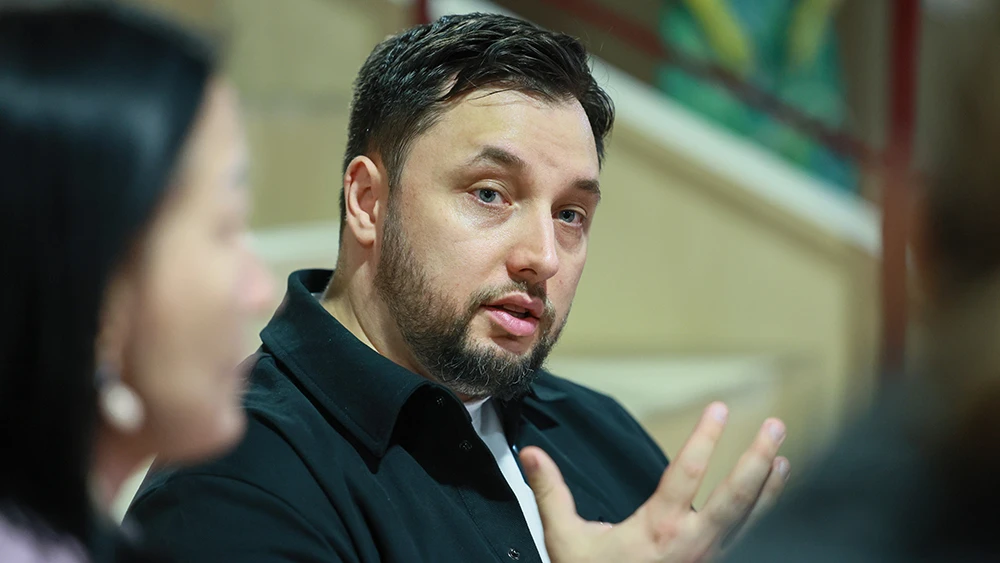
Hanging pictures on walls is not enough to create an exposition. A good exposition is like a performance, in which its content becomes the scenery and the visitor plays the leading role. Anton Okoneshnikov, director at the Alexandrinsky Theatre, laureate of the D.S. Likhachev National Award in the field of museum work, and multiple nominee for the Russian National Theatre Award "Golden Mask", spoke to visitors at the National Centre RUSSIA about how exposition space can become a tool of directing. He also created the audio guide for the "Legacy. Theatre. The Greats" exposition. The lecture named "Directing Exposition Spaces" took place on 20 September as part of the cultural-and-educational programme of this very exposition.
The audience learned how the dramaturgy of a route through an exposition is constructed — from the first steps to the resolution, from development to the climax — and how pauses, light, colour, rhythm and other accents and tools of directing work within an exposition space. Anton Okoneshnikov also addressed one of the key questions: what should a director do when working alongside outstanding exhibits? According to him, the most interesting task is not to "outshout" the creators of great works, but to explain to visitors why a particular exhibit deserves their attention.
"If an exposition consists entirely of masterpieces — for instance, paintings by Repin, Bryullov, Vasnetsov and other outstanding artists — what is the exposition director supposed to do alongside them? The works of these masters are good in their own right, without any directing. So the task is to make the exposition explain to visitors who have, so to speak, just come in off the street why a particular exhibit is worth looking at. And that is a very interesting task," said Anton Okoneshnikov.
The speaker shared his thoughts on the directing of the "Legacy. Theatre. The Greats" exposition itself. He praised the idea of taking visitors through theatre workshops — behind-the-scenes spaces that audiences do not normally enter — so that they can see and understand that a performance is created not only by actors and the director, but also by hundreds of other people whose names sometimes do not even appear in the credits. According to Anton Okoneshnikov, this is precisely the skill of an exposition director: immersing visitors in new material and giving them a point of reference for understanding and inspiration.
"The idea is that you come to the exposition and meet people who work in different theatre workshops — and they are, in the best sense, crazy people, because they are passionate about their work and it is their true calling. Then you step onto the 'stage' and realise the most important thing: it turns out that behind every great performance there are not just one director and fifteen actors, but hundreds of people who will never appear in any credits. And the 'Legacy. Theatre. The Greats' exposition is, in a sense, a hymn to these people — props managers, stage property makers and set designers — whom you will never see while sitting in the auditorium," Anton Okoneshnikov concluded.
The "Legacy. Theatre. The Greats" exposition at the National Centre RUSSIA is a large-scale project marking the 150th anniversary of the Union of Theatre Workers of Russia and implemented with the support of the Ministry of Culture of the Russian Federation and the Presidential Fund for Cultural Initiatives. The exposition is held under the motto "A Union of Happy People". Visitors can see unique exhibits and discover the world behind the scenes of the theatre until 25 September. Admission is free of charge. Prior registration on the russia.ru website is required to take part in a guided tour or the cultural-and-educational programme.