

The skeleton that became the star of the stage: an unusual exhibit at the "Legacy. Theatre. The Greats" exposition
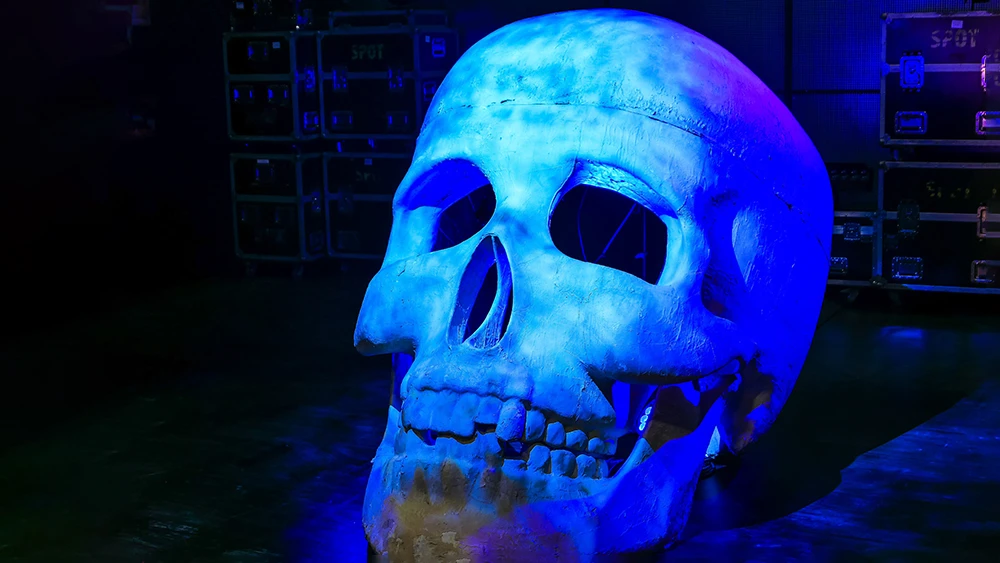
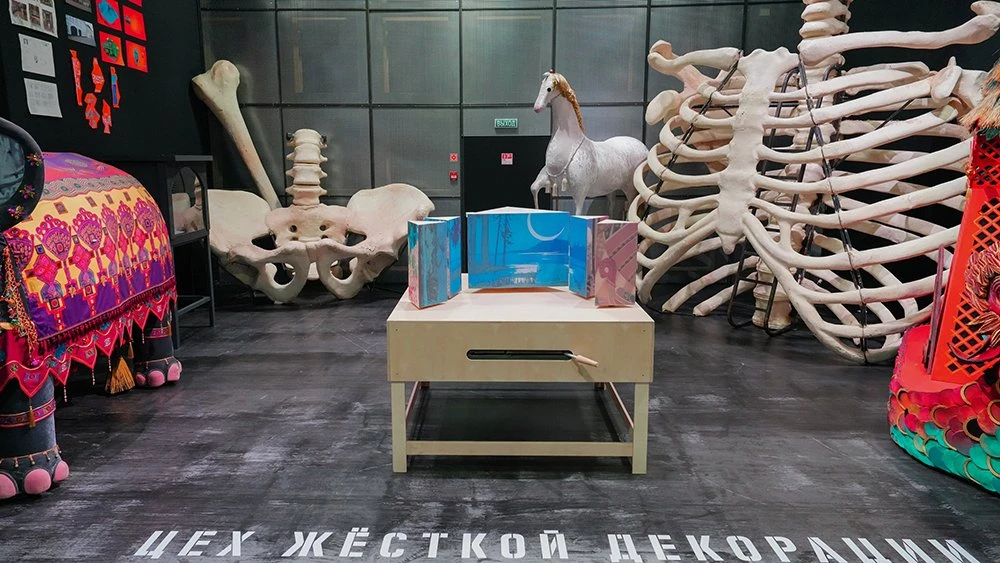
Visitors to the "Legacy. Theatre. The Greats" exposition at the National Centre RUSSIA can see one of its most unusual theatrical exhibits — a giant skeleton from the production "Little Tragedies" by the A. A. Bryantsev Saint Petersburg Theatre for Young Audiences. Made of polystyrene foam on a metal frame and coated with epoxy resin, it became a fully-fledged participant in the action and one of the production's most memorable images. The "Legacy. Theatre. The Greats" project is being implemented with the support of the Ministry of Culture of the Russian Federation and the Presidential Foundation for Cultural Initiatives. The exposition is organised by the Union of Theatre Workers of Russia.
The production, directed by Ruslan Kudashov, premiered in 2015 and remained in the theatre's repertoire for ten years. The skeleton was conceived by the director together with artist Nikolai Slobodyanik and became the largest "puppet" in Ruslan Kudashov's work. He is known for seamlessly combining the aesthetics of puppet theatre and drama theatre.
In the first act, the skeleton appears before the audience dismantled into separate parts. The skull, rib cage and bones become elements of the stage space, serving in turn as a hiding place for Donna Anna, a platform for Laura and expressive props accompanying the action. In the second act, the structure is assembled into a single whole: the giant figure rises almost to the full height of the proscenium, becoming at once the Stone Guest, an embodiment of Fate and an ominous symbol of destiny. Thanks to suspension mechanisms and lighting effects, the skeleton literally comes to life — its jaw and facial bones move, creating a sense of a living presence on stage.
Director Ruslan Kudashov noted that through the characters of Pushkin's "Little Tragedies", the production explores human passions, weaknesses and the inevitable encounter with fate. This is why the skeleton becomes the central metaphor of the production, uniting all four works by Alexander Pushkin.
The unusual scenography was highly praised by theatre critics. Reviews described the giant skeleton as the central figure of the stage space and noted that it simultaneously embodies Fate, the Plague, the Stone Guest and Man himself. Over the years, this large-scale theatrical object not only toured Russia, but was also presented in France as part of the "St Petersburg Seasons" project in Avignon.
The legendary exhibit can be seen at the "Legacy. Theatre. The Greats" exposition at the National Centre RUSSIA, where it offers a glimpse behind the scenes of theatre and shows how scenography can become an artistic statement in its own right. Admission to the exposition is free. Advance registration on the russia.ru website is required for a guided tour.