

Vladimir Putin and Narendra Modi visit "INNOPROM. India", featuring the National Centre RUSSIA stand

The
International Industrial Trade Fair "INNOPROM. India", held at the
Bharat Mandapam complex in New Delhi from 9 to 11 September, has concluded. On
the final day of the exposition, the President of Russia, Vladimir Putin, and
the Prime Minister of India, Narendra Modi, visited the venue. One of the
fair's key participants was the National Centre RUSSIA, which presented its flagship
project, the Department Store, as well as a Russian cultural zone dedicated to
folk arts and crafts.
Over the three days, the National Centre RUSSIA stand became one of the most
visited at the fair. The Department Store brought together products from more
than 160 Russian manufacturers from across the country's regions, ranging from
consumer goods to items reflecting Russia's cultural diversity.

Among the most popular products was clothing featuring quotes by the President of Russia, Vladimir Putin. The National Centre holds the exclusive right to produce these items, with the phrase "Next time in Moscow" proving the most popular. A special series of nevalyashkas (roly-poly toys) in Indian national dress attracted just as much interest. The famous Russian toy, symbolising resilience and the ability to bounce back, was the first product purchased by visitors within minutes of the fair opening, and by the end of the second day the nevalyashkas had completely sold out. Treats, including gingerbread, chocolate and much more, were also in particularly high demand. Russian crystal found its buyers as well, confirming visitors' enduring interest in high-quality products rooted in Russia's rich tradition of craftsmanship.

The stand was designed as an octagonal arched structure: monochrome and berry-coloured on the outside, and decorated inside with elements of traditional Russian painting. The main areas of the stand — screens, a model of the future building and the Department Store — were arranged beneath the outer arches along the sides of the octagon. Particular attention was also paid to decorative elements, including macramé, Khokhloma painting and red and green tiles. They complemented the visual identity of the exposition, combining motifs of Russian decorative and applied arts with a contemporary approach to spatial design.

The fair was also visited by the heads of the relevant Russian and Indian ministries, Anton Alikhanov and Piyush Goyal. They toured the National Centre RUSSIA stand and the cultural zone.

In New Delhi, the National Centre also presented a special Russian cultural zone. Throughout the fair, artisans from the Ryazan, Nizhny Novgorod and Kirov Regions, as well as the Khanty-Mansi Autonomous Area — Yugra, demonstrated traditional techniques from their regions and told visitors about the distinctive features of their crafts, introducing international guests to the richness and diversity of Russian decorative and applied arts.

The exposition displays also featured unique examples of handmade Russian decorative and applied art, from crystal and Dymkovo toys to Caucasian carpet weaving and northern lace. The items included products from Gus-Khrustalny, Dymkovo toys, amber items, Kislovodsk porcelain, fur products, Yelets, Mikhailov and Vologda lace, a Dagestani carpet, Fedoskino miniatures, gold items and much more.

INNOPROM was held in South Asia for the first time. The event was organised by the Ministries of Industry and Trade of Russia and India. The fair brought together more than 130 companies from Russia and India to develop business ties and joint industrial projects.

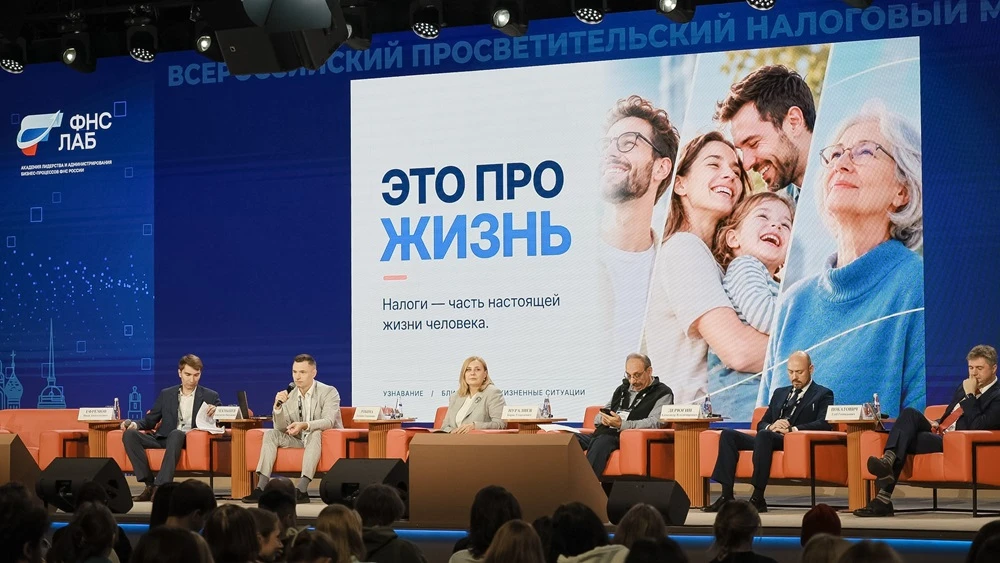
The event brought together young people, anyone seeking a better understanding of taxation, and representatives of government, business and professional communities.