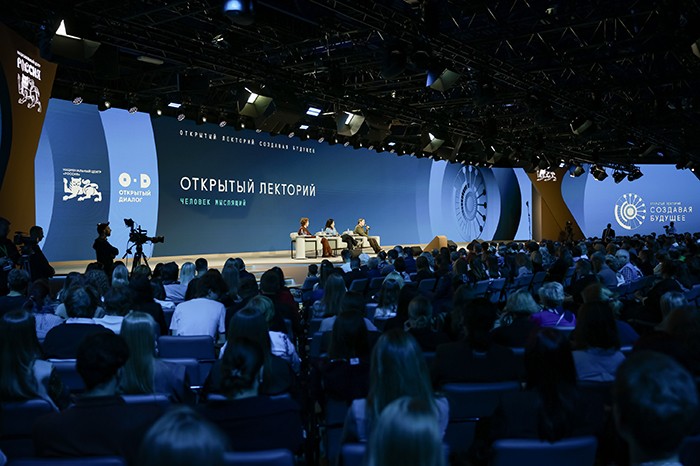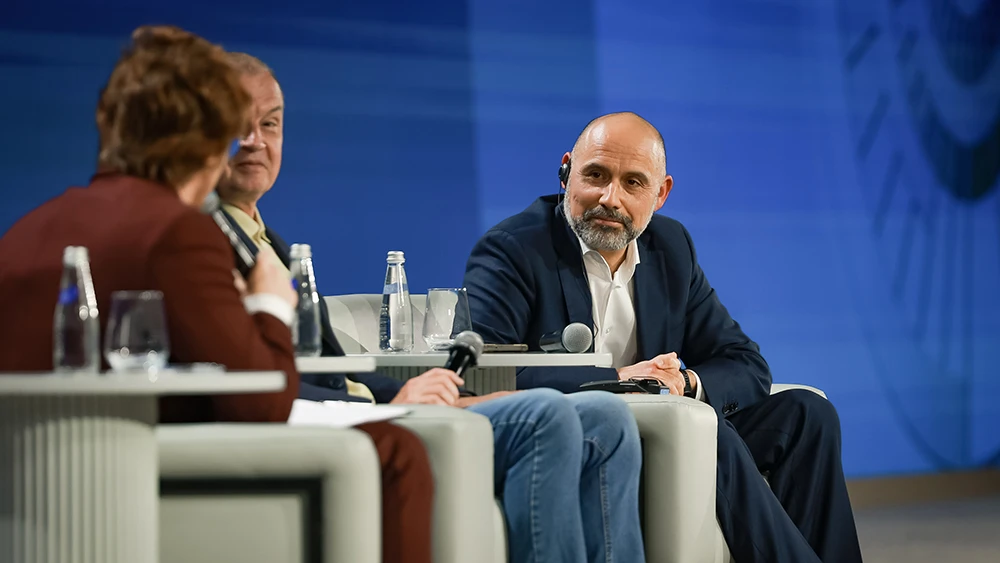


Experts of the Open Lecture Hall discuss protection of neurodata and human neurorights

Neurotechnology is gradually bringing humanity closer to the possibility of reading brain signals and creating new forms of human interaction. However, the development of such solutions requires determining in advance how neurodata, personal space and human identity will be protected. This was discussed on 26 September by Romulo Fuentes Flores, Professor at the Department of Neuroscience of the Faculty of Medicine of the University of Chile, and Mikhail Lebedev, Professor at the Faculty of Mechanics and Mathematics of Lomonosov Moscow State University, at the "Homo Sapiens or Homo Technologicus" section of the Open Lecture Hall "Inventing the Future: The Limits of the Human" at the National Centre RUSSIA.
Romulo Fuentes Flores noted that the discussion of neurorights is ahead of the current level of technological development, with many scenarios still remaining a prospect for the future. At the same time, he said, ethical and legal frameworks need to be discussed now. The scientist stressed that the brain cannot be considered separately from the person — their body, sensory experience, and individual and evolutionary history.
"I believe that we need to be extremely cautious. Neurorights are somewhat ahead of us; they do not yet really exist, they are intangible, but we will need them in the future, and this is an ethical issue that we need to keep in mind. Neurorights are based on our personality, which we tend to think is rooted exclusively in our brain, but that is not quite the case: the brain and sensory perception are inseparable. The brain is part of my body, but we are perceived as a whole, as a kind of unity; we cannot separate the brain from a person's identity," the expert said.
He also added that neurorights may include the protection of neurodata as private information, and cited an example in which an experiment participant demanded that data obtained by a device for reading brain signals be deleted because they believed their privacy had been violated.
Mikhail Lebedev, in turn, described the protection of information about brain activity as an important issue, but clarified that it is still too early to address it in practical terms. According to him, brain signal reading could theoretically provide insight into a person's state and intentions, but there is currently no mass collection of such data. At the same time, neurotechnology is already developing, which means that discussion of its regulation will become increasingly relevant.
The scientist stressed that the development of brain-computer interfaces opens up significant opportunities for medicine and rehabilitation. At the same time, it raises a question for society: what data about the brain can be collected, where it should be stored, and who will be responsible for its use.